Blog

Wheat & farming · 578 articles / Newest firstClear filters

2012 / 04

Peka and Klappfen

Do you know Eiko Funada (舟田詠子)? She’s a Vienna-based food historian of bread who has written books such as Christmas No One Knows and A History of Bread Culture. Not long ago, she returned to Japan and held a lecture event about Dubrovnik. Dubrovnik is a Croatian city called “the Pearl of the Adriatic,” where a fortified wall surrounds small islands and, within it, buildings dating back to the Middle Ages stand in rows.

Discuss this article ↗

2012 / 03

Lotus Baguette (Nakameguro)

No. 141 (an adventure around 200 places in Tokyo): You probably can’t make good bread unless you’ve spent years training as a bread craftsman. Since it’s not something related to the bread industry, could you use the sense and know-how you’ve developed in other fields to break fixed ideas and create a new kind of bread? Lotus Baguette, operated by the Hollywood Lunch Market (Seirin Co., Ltd.), is… (Owner Gen Tampaku’s “

Discuss this article ↗

Bread ad-lib

Dandizon, which has a meaning of “10 years from now,” started making bread with homemade yeast two years ago. It was in their eighth year, with the eighth year marking a milestone. I thought the bread of Dandizon, with its quiet, beautiful stillness that feels like it might be displayed in a museum, was something only yeast could bring out—so it was a happy, unexpected surprise. The efforts of Chef Kimura, who keeps making trial batches between his busy routine…

Discuss this article ↗

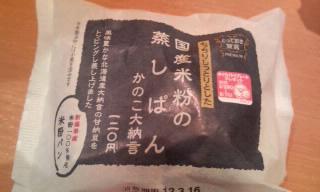
I boldly bought steamed buns made with domestic rice flour—kanoko (Kano-ko) and large red bean paste (dai-nagon).

On days like this it’s like, “It’s such nice weather by the bayashiwa.” The proper way in places like Daikanyama, Ebisu, or Jiyugaoka is to buy one or two breads that match what you’re looking for from a local bakery, then eat them while looking out at the distance from a park bench. While imagining that, I stopped by Lawson. The reason is that I was walking around Kabukicho. In Shinjuku, there are stylish and delicious bread shops, and I

Discuss this article ↗

Trasparente (Nakameguro)

No. 138 (An adventure covering 200 places in Tokyo) From the shop name, from the interior and exterior, the image I had of Trasparente was “a highly tasteful shop that was so sotisfykate(d)…” What symbolizes that is the cube: a perfectly square brioche filled with custard. It was a signature product that the media featured again and again, yet now this bread isn’t on display in the shop. “March 11th

Discuss this article ↗

Maison de Charité Repas (Hon-Yawata)

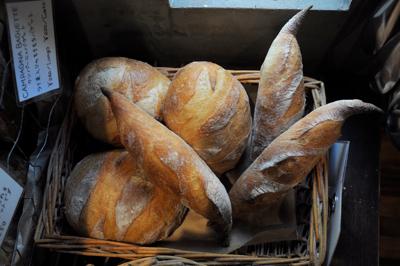
No. 137 (An adventure covering 200 places in Tokyo) The French word repas in the shop name means “a meal.” The lineup centers on meal breads like sandwich bread, baguettes, and campagn(e) breads. If it were in the center of Tokyo, sure, but in the suburbs—continuing the shop while narrowing it down to simple breads is extremely difficult. Small differences in taste can greatly influence customers’ foot traffic. Relying on craftsmanship and sensibility, you cross that tightrope…

Discuss this article ↗

Shekazama (Hanzomon)

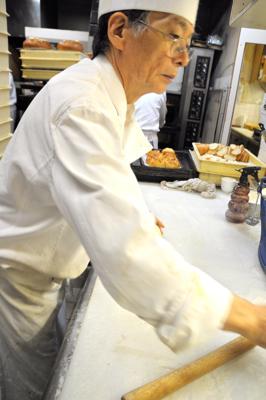
No. 136 (An adventure covering 200 places in Tokyo) Toyoji Kazama. This person’s career is basically the very history of Japanese bread. “I’m 73 now. I became a bread craftsman right after junior high school, so I’ve been in this world for 58 years. The person who made Japan’s first yeast, Marujyu yeast, is my uncle. Because of that connection, in Showa 30 (1955) I joined Marujyu Seipan, and in Showa 45 (1970) I went to Donq,”

Discuss this article ↗

2012 / 02

“The Present of the Origins of Bread” Talk-Show Report

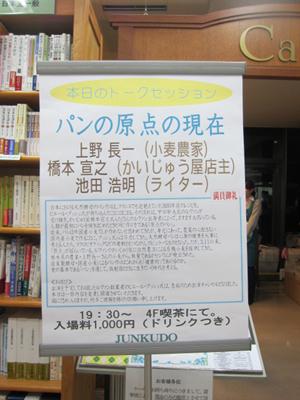
Even though in the talk show “The Present of the Origins of Bread,” a Pan Lab release commemorative talk show held at the Junckudo Bookstore Ikebukuro Honten on Saturday, February 11, Mr. Pierre Busch—who was scheduled to appear—could not suddenly due to illness, many people came. Thank you very much. Mr. Nagakazu Ueno, a wheat farmer (on the left). For this day, Mr. Ueno… from Tochigi Prefecture

Discuss this article ↗

Rich-flavored Giffere Asahi Shimbun

It seems that rich flavors are popular in the food industry. *The article from the Nikkei is here. While there have been breads that tout themselves as rich in convenience stores for quite a while, in each case, what becomes rich is only the filling inside the bread or something applied to the surface. If you could buy something like “bread with a rich wheat flavor” at a convenience store, you might think, “Oh!” What else would become rich in bread, I wonder…

Discuss this article ↗

Bread and Radioactive Contamination: Mikio O koda’s Thoughts

Levan is said to be one of the pioneers of homemade sourdough bread. In addition, there was another groundbreaking thing: the conventional wisdom up until then that bread could only be made with imported wheat. Instead of buying wheat flour from a milling company, they mill wheat grains they purchase directly from producers in Japan. For the seeds, they use whole wheat flour; they use not only the white parts, but also bran full of minerals and dietary fiber.

Discuss this article ↗

The Man Who Passed Down Campagne: Pierre Busch [Craftsman Interview 007]

Pierre Busch In 1981, he founded Levan, the first shop in Japan specializing in homemade sourdough starter bread. In 1985, he established (株) Nova, which handles importing organic ingredients and also works with homemade sourdough starter bread using domestic wheat. Currently, he has closed the bakery division and is busy with research on yeast. “In the history of Japan’s bread. In that puzzle, there is no important piece. If things go on like this, the puzzle… will last forever…”

Discuss this article ↗

Bluff Bakery

No. 134 (An Adventure Visiting 200 Places in Tokyo) Yokohama Motomachi is the birthplace of bread. When Japan opened to the world at the end of the Edo period, an alien settlement was created in this area, and in it, bakeries for English and American people opened early on. The first person in Japan to bake sandwich bread was Uchiki Bakery, which is now located in Motomachi. This town is also the origin of the familiar bakery chain, Pompador. From the Motomachi Shopping Street, if you go down…

Discuss this article ↗

2012 / 01

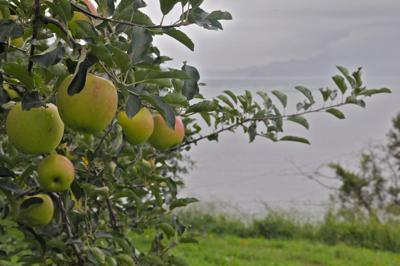
Apple Day: 12 Famous Shops Sell Breads Using “Hope Apples”

We’ll be holding an event with our feelings of support for the disaster-stricken areas. We had you join us at 12 wonderful bread shops (11 in Tokyo + 1 in Osaka). Please go visit a shop near you. Apple Day—We will sell breads made from apples that survived the tsunami. On March 11, the tsunami caused catastrophic damage to Rikuzentakata City. Industrial facilities such as fishing…

Discuss this article ↗

Is Fukushima wheat safe?

As someone who eats bread every day, there are things I want to know. Is domestically produced wheat safe right now? I also wanted to ask another issue that’s related to that, and connected on both sides. When we consumers refuse bread containing radioactive material, how does that affect people in Tohoku? I asked Akizō Abe, president of the milling company Abe Seifun in Koriyama, Fukushima Prefecture. On December 20, radioactive cesium…

Discuss this article ↗

Mälzzeit (Myōgadani)

Number 132 (An Adventure Touring 200 Shops in Tokyo) Homemade yeast can be made from various foods. Flour such as wheat and rye, fruits such as raisins, and beer yeast or sake starter (shukōshu). You can’t see it, but yeast cells are attached to the surfaces of those foods, and by humans taking care of them and warming them, their activity becomes more active and the bread rises. In other words, life is breathing. We…

Discuss this article ↗

2011 / 12

Low/Rowan Montagne (Prince)

No. 130 (An Adventure Touring 200 Places in Tokyo) This shop is a local bakery that anyone can drop into casually. On the natural yeast, domestic wheat bread shop that people often say is “hard to eat,” customers of a wide range come flocking in—from elderly people to salarymen, to housewives. Hard-type breads, sliced bread, anpan, curry bread, and Danish pastries. All of them are absolutely no inferior to yeast-based breads in the least,

Discuss this article ↗

AOSAN Bread Story

The lightness of that strange dough, like it has surpassed the very substance/physical feel of AOSAN bread. The beautiful fragrance of fermentation. The flavor seeps out every time you bite into it. The line of people waiting for the baked loaves of kakushoku continues in front of AOSAN’s shop again today. How was it created? After working at a Western confectionery shop, Mr. Okuda trained at the famous bakery of homemade yeast, “Luvan,” and opened AOSAN. “In the world of bread...

Discuss this article ↗

2011 / 11

EATALY (Daikanyama)

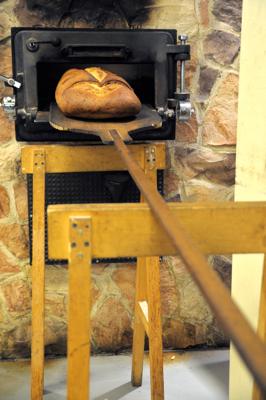
No. 128 (An Adventure to Visit 200 in Tokyo) Eataly, the largest Italian food retailer in Japan. Inside the 23 wards, it’s rare to find a brick bread-baking wood-fired oven in the store. Just like an electric oven, it’s not that the oven’s temperature automatically rises to the preset level just because you press a button. You feed the firewood, keep an eye on the oven constantly, and use your instincts to bring the bread to the desired finish. Chef Takeda says, “The thermometer is—”

Discuss this article ↗

Bread Workshop Kazamidori (Higashiurawa)

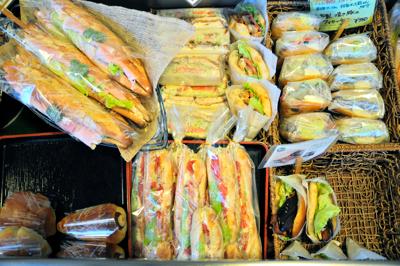
No. 125 (An Adventure to Visit 200 in Tokyo) The first thing you notice when you walk into the shop is this. Light pouring down from a high ceiling illuminates the many sandwiches lined up in the refrigerated display case in a riot of colors. The breads in this shop are giving off light. When you go to Kazamidori, you have to go hungry—or you’ll regret it. There are too many breads I want to buy. Not a single one is ordinary bread—

Discuss this article ↗

パンラボ · 朝日新聞「このパンがすごい!」