The Dementia Mismatch
Why people living with dementia need personalized AI services, why that has to start with a marketplace, and what data such a service will have to integrate.
The argument in eight steps
- We are thinking about people with dementia. 57 million people worldwide, 4.4 million in Japan, nearly a million in Korea, 7 million in the United States — and the numbers roughly double by 2050.
- The most important thing is the match and mismatch between four groups: the person living with dementia, the companies that want to sell products, the professionals and carers whose job is to help, and the worried family.
- So I researched whether those mismatches exist. They do, and they are measurable — in self-ratings versus proxy ratings, in abandoned devices, in a care-robot market thirty times smaller than forecast, in carers who are short of time.
- What I realized is that every person needs services personalized to them. AI should not only make services better; it has to make them fit — the right service, in the right form, at the right time, for this one person.
- So first we need marketplaces where a person and their family can see and choose the services that fit them best.
- There are several ways to build such a marketplace — consumer platforms, managed care networks, employer- or insurer-paid navigators, publicly funded navigation, and AI "front doors".
- One example is the US company Counsel Health (often called "Counsel AI"); others range from Honor, Lottie and Homage to the CMS GUIDE participants and Japan's LIFE system.
- What I have to think about next is how to integrate all the medical data each person needs for the best service — the complete list of data types is at the end of this note.
We are thinking about people with dementia
In 2021, 57 million people were living with dementia; nearly 10 million more develop it every year, and over 60% of them live in low- and middle-income countries.1 The global cost was US$1.3 trillion in 2019, and about half of that is informal care — family members who provide on average five hours of care and supervision a day, 70% of those hours by women.1,2
The WHO and Alzheimer's Disease International expect 78 million people with dementia by 2030 and 139 million by 2050;2,3 the Global Burden of Disease forecast published in The Lancet Public Health is higher still — 152.8 million by 2050 (uncertainty interval 130.8–175.9 million), a 166% increase on the 57.4 million of 2019.4 ADI estimates that 75% of people with dementia are not diagnosed — about 41 million people — and that the share reaches 90% in some low- and middle-income countries.5 Cost is expected to reach US$1.7 trillion by 2030, or US$2.8 trillion if corrected for rising care costs.2
Sources: WHO Global status report press release, 2 Sep 2021 (55M in 2020 → 78M in 2030 → 139M in 2050)2; ADI dementia statistics3; GBD 2019 Dementia Forecasting Collaborators, Lancet Public Health 2022 (57.4M in 2019 → 152.8M in 2050)4. The WHO fact sheet's 57M refers to 2021.1
Japan: more than ten million people when MCI is counted
The latest estimate commissioned by the Ministry of Health, Labour and Welfare (Kyushu University, Prof. Toshiharu Ninomiya, published May 2024) puts the number of people aged 65 and over living with dementia at 4.432 million in 2022 (12.3% of the age group), plus 5.585 million with mild cognitive impairment (15.5%) — together more than 10 million people, roughly one older adult in 3.6.7,8 The projections rise to 5.842 million with dementia in 2040 (14.9%) and 6.451 million in 2060 (17.7%), with MCI plateauing around 6.3 million.7 Young-onset dementia affects about 36,000 people (50.9 per 100,000 aged 18–64).8 For context, the 2015 New Orange Plan had expected about 7 million people with dementia by 2025 — one in five older adults;9 the new estimate is lower in headcount because cohorts are healthier, but the combined dementia-plus-MCI population is larger than anyone planned for.
Source: 厚生労働省「認知症及び軽度認知障害の有病率調査並びに将来推計に関する研究」(研究代表者 二宮利治), 2024.7 Dementia: 443.2 (2022), 471.6 (2025), 523.1 (2030), 584.2 (2040), 586.6 (2050), 645.1 (2060). MCI: 558.5, 564.3, 593.1, 612.8, 631.2, 632.2.
Source: Keio University School of Medicine (佐渡充洋ら), 2015: medical ¥1.9T, long-term care ¥6.4T, informal care ¥6.2T.10 The same group projects ¥24.26 trillion in 2060 (1.6× the ¥15.0 trillion of 2015).10
Source: 警察庁「行方不明者の状況」各年.11 2023: 19,039 (21.1% of all 90,144 reports); 2024: 18,121 (491 found dead, 382 of them — 77.8% — within 5 km of home); 2025: 17,345 (21.6% of 80,486; about 95% located within three days; 573 found dead). 2012–2015 values via nippon.com and the NPA's 2015 report.†
Korea and the United States
Korea's 2023 national dementia epidemiology survey (published March 2025) found a prevalence of 9.25% among people aged 65+ and 28.42% for MCI; it projects 970,000 people with dementia in 2025 (9.17%) and 2.98 million with MCI, the one-million mark crossed in 2026, two million in 2044, and a peak of 2.33 million in 2059.19 The national dementia-management cost was ₩22.9 trillion in 2023 (0.95% of GDP), or ₩26.39 million per person per year.20 In the United States, 7.2 million people aged 65+ live with Alzheimer's disease; nearly 12 million family members and friends provide 19.2 billion hours of unpaid care valued at $413 billion, and formal care costs are projected at $384 billion for 2025.21 (The 2026 edition updates these to 7.4 million, 13 million, $446 billion and $409 billion.21)
Prevention is also personal: the 14 risk factors
The 2024 Lancet Commission estimates that 45% of future dementia could be prevented or delayed if 14 modifiable risk factors were eliminated; the two factors added in 2024 — high LDL cholesterol in midlife and untreated vision loss in late life — account for 7% and 2% respectively.6 No two people carry the same set, which is the first reason any serious prevention or care service has to be personal.
The lens: match and mismatch among four groups
Each of the four groups has a legitimate goal, and each goal is a proxy for the same thing: a good life for the person. But proxies drift. A family buys safety; a company builds what the buyer fears; a care facility buys what fits its workflow and budget; a professional rates needs the person does not feel. The diagram shows the four groups, what each tends to optimize for, and the six relationships between them. The numbers on the edges come from the evidence in the next section.
The six relationships, each with one measured mismatch from §03. "Old-old care" = both the carer and the cared-for person are 65 or older (老老介護).
So I researched whether the mismatches exist. They do.
3.1 The person versus the family
The clearest evidence is the gap between how people with dementia rate their own lives and needs and how the people closest to them rate them on their behalf. In 1,330 dyads across European home- and institutional-care settings, people with dementia rated their quality of life (QoL-AD) at 33.2 on average, their proxies at 29.8, and item-level agreement was poor (κ < 0.20 for all but one item).22 In 266 US dyads with mild to moderate dementia, caregivers "consistently underestimated" the importance the person placed on all five values measured — autonomy, burden, control, family and safety — and over four years the caregivers' perception of what mattered to the person decreased further.23
Needs are rated differently too. In a UK study of 152 people with dementia living at home, the person reported on average 1.17 unmet needs, their carers 2.14, and the professionals 2.64; "daytime activities" were rated unmet for 14.5% of people by the person, 41.1% by carers and 50.7% by professionals, while the person's own most-cited unmet need was psychological distress (21.6%).24 A Dutch CANE study (236 people, 322 carers) found the same pattern: people with dementia report fewer (unmet) needs than their carers, with the most unmet needs in memory, information, company, psychological distress and daytime activities.25
Source: Miranda-Castillo, Woods & Orrell, BMC Health Services Research 2013.24
Source: Miranda-Castillo et al. 2013.24 The person's own top unmet need was psychological distress (21.6%).
The safety–autonomy tension is the sharpest form of this mismatch. In interviews about GPS tracking, carers gave "preference to patients' safety more than autonomy when they are responsible for the patients", and the main benefit identified was "the peace of mind of the caregivers themselves".26 When 296 family and professional carers were asked who should decide whether a person with dementia is tracked, the person themselves ranked third — after the spouse and the most-involved family carer.26
Japan's own public opinion shows the same structure from the other side. In the Cabinet Office's August 2025 survey (1,707 valid responses), the most common fear about developing dementia was "placing a physical or mental burden on my family" (74.6%), ahead of "losing memories of my family" (51.8%). Asked how they would want to live with dementia, 27.1% chose staying in the community with medical and care support and 15.1% living independently with some support, while 42.4% chose moving to a facility — and 27.5% of those gave as their reason "so as not to trouble the people around me". 35.6% still picture dementia as "unable to manage daily life, needing admission", and 75.3% did not know the Basic Act on Dementia exists.27
Source: 内閣府「認知症に関する世論調査」令和7年.27 Of those choosing a facility, 27.5% did so "so as not to trouble those around me".
3.2 The person versus the companies
The second mismatch is between what is sold and what is used. The classic study of assistive technology found that 29.3% of all devices were completely abandoned, that abandonment peaked in the first year and again after five years, and that the strongest predictor was "lack of consideration of user opinion in selection".28 A systematic review catalogued 539 intelligent assistive technologies for dementia — growing by roughly 400% every five years — but concluded that "structural limitations to successful adoption" persist, "including partial lack of clinical validation and insufficient focus on patients' needs", and that a significant portion is designed without explicit ethical consideration.29
Reviews of the design process say why. Mobile technologies for dementia "support basic physiological and safety needs, whereas many pay little attention to higher-level needs such as self-esteem and agency"; "little attention seems to be paid to personhood".30 In development projects, people with dementia were mainly "objects of study and informants" rather than co-designers;31 the INTERDEM network's position paper notes that people with dementia want to be included, and a 2025 umbrella review of 112 systematic reviews still lists "personalization of applications" as the unsolved development challenge.31 In real households, "access to AT was driven by carers, with the majority of benefits being experienced by carers", and families improvised do-it-yourself devices because formal provision did not meet their needs;32 a review of 79 papers on surveillance technology in residential care found "little attention for the resident perspective".33
The commercial consequence in Japan is stark. The Japan Research Institute estimates that people with dementia or MCI living at home spend about ¥14.74 trillion a year (2025), yet products and services adapted to them are projected at only ¥98.7 billion in 2030 — a 1.7% "replacement rate" — and ¥531.3 billion (8.6%) in 2050.34 The money is there; the fit is not.
The MIND at Home baseline study in Baltimore (254 people with dementia living at home, 246 caregivers) shows that both sides are under-served, but in different domains — which is itself a design brief. 99% of the people with dementia had at least one unmet need (mean 7.7), concentrated in safety (90%; fall risk 70%, wandering risk 33%), general health care (63%), meaningful activities (53%) and legal/advance care planning (48%); 32% had never had a dementia evaluation. 97% of caregivers had unmet needs (mean 4.6), but theirs were referrals to resources (88%), dementia education (85%) and mental-health care (45%).46
Source: Black et al., JAGS 2013 (MIND at Home baseline).46
Source: Black et al., JAGS 2013.46
3.3 The companies versus the professionals and carers
Japan's care-robot story is the cleanest example of a supply-side forecast meeting a demand side that did not buy. In 2013 METI projected a potential market for nursing-care and welfare robots of ¥123.9 billion in 2025 and ¥404.3 billion in 2035.35† Yano Research measured the actual care-robot market at ¥2.175 billion in FY2021 and forecast ¥3.625 billion for FY2025 — roughly one-thirtieth of the projected potential — and attributed growth prospects only to products whose "functions and prices have been revised to reflect user needs".35 (The broader care-DX software market was ¥54.58 billion in FY2024.35)
Sources: METI 2013 projection as reported by 産業タイムズ35†; 矢野経済研究所 2022.35
Adoption is finally rising, but for reasons that have little to do with the person with dementia. In the MHLW's 2025 survey of 6,875 establishments, 47.2% of residential and overnight services had introduced monitoring devices (30.0% in FY2022) and 56.4% care-operations support systems (10.2% in FY2022). Among the 1,292 non-adopters, the reasons were initial cost (67.9%), running cost (48.8%), the need for staff training (36.1%) and "difficulty choosing devices suited to the problems on our floor" (32.1%); 67.3% had never applied for a subsidy.36 What care workers actually do with their time explains the appetite: in an MHLW time study, direct care took 40.9% of an eight-hour shift (196.4 minutes), records 9.0% (43.1 minutes) plus 4.5% transcribing them, movement 18.5% and other indirect work 21.0%; after technology was introduced, documentation fell to 6.0%.37 Yet only 49.4% of establishments felt a lighter daytime burden and 44.6% at night.38
Source: 厚生労働省 介護給付費分科会 第255回 (2026), n = 6,875.36
Source: same survey.36 67.3% of non-adopters had never applied for a subsidy.
Source: 厚生労働省 介護テクノロジー等による生産性向上の取組に関する調査及び効果測定事業 (2026).37 After technology introduction, records fell from 9.0% to 6.0% of the shift.
3.4 The professionals versus the families
Families want hands; the system is short of them. Japan had about 2.15 million care workers in FY2022 and needs about 2.40 million in FY2026 (+250,000, or 63,000 a year) and 2.72 million in FY2040 (+570,000).16 The job-openings-to-applicants ratio for care occupations was 3.97 in March 2025 against 1.16 for all occupations.39 65.2% of establishments report a staff shortage (83.4% for home-visit helpers), even though turnover fell to a record-low 12.4% — the problem is recruitment, not churn.38 Globally, the WHO projects a shortfall of about 11 million health workers by 2030.40
Meanwhile the family is older, fewer and still working. In 2022, in 63.5% of co-resident caregiving pairs both people were aged 65 or over (59.7% in 2019), and in 35.7% both were 75 or over; 63.1% of co-resident main carers of someone at care level 5 provided care "almost all day", and 74.5% of all-day carers were women.15 106,000 people left their jobs for caregiving in the year to 2022 (99,000 in 2017); 6.29 million people were caring for a family member, 3.65 million of them while employed.14 The mental-health cost is documented: across 17 studies and 10,825 caregivers of people with Alzheimer's, 34.0% had depression, 43.6% anxiety and 27.2% used psychotropic medication; spousal carers had 2.51 times the odds of depression.41 ADI's 2022 surveys found 54% of informal carers stressed "often or all of the time" (92% to some degree), while 37% of paid professionals were stressed often or always and 47% said they were not adequately compensated.42
Source: 厚生労働省 第9期介護保険事業計画に基づく介護職員の必要数 (2024).16
Source: Sallim et al., JAMDA 2015.41 Spousal caregivers: OR 2.51 for depression.
Source: ADI 2022.42
3.5 The system itself
Behind the four groups sits a health system that too often never starts the conversation. 75% of people with dementia are undiagnosed; in ADI's 2021 survey of 1,111 clinicians and 2,325 people with dementia and carers, one in three clinicians believed nothing could be done, making diagnosis futile.5 In the 2019 attitudes survey of almost 70,000 people in 155 countries, almost 62% of healthcare providers thought dementia was a normal part of ageing, 40% of the public thought doctors and nurses ignore people with dementia, and 35% of carers had hidden the diagnosis.43 After diagnosis, 37% of people in high-income and 45% in lower-income countries were offered no support; 64% had no personalised care plan, and ADI estimates that up to 85% of people with dementia miss out on post-diagnosis care.42 Only a quarter of countries have a national dementia plan.2 Japan has its own "blank period": in a Sendai survey, 61.2% of families started long-term-care services within a year of diagnosis, but 17.1% took three years or more, and longer gaps meant heavier mental, physical and financial burden.44†
Sources: ADI World Alzheimer Reports 20215, 201943 and 202242.
3.6 Where the interests match
The good news is that the four groups agree on the destination. 77% of US adults aged 50+ want to stay in their own home and 79% in their community;45 in Japan 49.3% would want to stay in the community versus 42.4% in a facility — and the facility choice itself is often motivated by not wanting to burden the family, so the underlying wish is shared.27 Both the person and the carer are almost universally under-served (99% and 97% with at least one unmet need46), which means a service that addresses both is wanted by both.
And personalised coordination demonstrably works. In the MIND at Home randomised trial (303 people, 18 months), care coordinators with "individualized care planning" cut the adjusted hazard of leaving home by 37% (HR 0.63, 95% CI 0.42–0.94), reduced unmet safety and legal needs, and improved self-reported quality of life.47 The money exists: people aged 50+ generated $12.5 trillion of US economic activity in 2024 — 43% of GDP.48 What fails is fit.
| Relationship | What each side optimizes for | Measured mismatch | Source |
|---|---|---|---|
| Person ↔ Family | Autonomy, staying home, not being a burden ↔ safety, peace of mind | QoL-AD 33.2 self vs 29.8 proxy; carers under-estimate all five values; person ranks 3rd as decision-maker on GPS; 74.6% of Japanese fear burdening family most | 22, 23, 26, 27 |
| Person ↔ Companies | Meaningful days, agency ↔ scalable products sold to the buyer | 29.3% abandonment; 539 technologies, "insufficient focus on patients' needs"; benefits accrue to carers; 1.7% of ¥14.74T spending served by adapted products (2030) | 28, 29, 32, 34 |
| Person ↔ Professionals | Psychological comfort, company ↔ clinically defined needs | Unmet needs 1.17 (self) vs 2.64 (professional); daytime activities 14.5% vs 50.7%; 32% never evaluated for dementia | 24, 46 |
| Family ↔ Companies | Reassurance ↔ features that sell to the frightened buyer | Technologies serve "physiological and safety needs"; GPS valued mainly for carers' peace of mind; surveillance reviews ignore the resident | 30, 26, 33 |
| Companies ↔ Carers | Products ↔ cost, training, fit with the floor | Care-robot market ≈1/30 of METI's forecast; non-adoption: cost 67.9%, fit 32.1%; records take 13.5% of a shift | 35, 36, 37 |
| Carers ↔ Family | Hands and hours ↔ expectations and respite | 2.72M workers needed by 2040 (+570k); openings ratio 3.97; 63.5% old-old care; 10.6万 job leavers; 54% of informal and 37% of paid carers stressed often/always | 16, 15, 14, 42 |
| Where they match | Everyone wants the person at home, well | 77–79% want to age at home (US); 49.3% community (Japan); individualized care planning: HR 0.63 for leaving home | 45, 27, 47 |
What I realized: personalization is the whole point
"Dementia" is not one condition and not one situation. The multimodal diagnostic model published in Nature Medicine in 2024 had to distinguish ten etiologies — Alzheimer's disease, Lewy body, vascular, prion, frontotemporal, normal-pressure hydrocephalus, systemic/external, psychiatric, traumatic brain injury and other — across 51,269 participants.84 Severity runs from CDR 0.5 to 3; behavioural symptoms are scored across twelve domains; the living situation ranges from a working daughter next door to an 80-year-old spouse caring alone; and the fourteen risk factors weigh differently in every life.6 A GPS tracker is relief in one household and an indignity in another.26 The MIND at Home result — 37% lower hazard of leaving home — came specifically from individualized care planning, not from a device.47
So AI has two jobs here, and today's products mostly do only the first:
Job 1 — Quality
Detect earlier (an MCI classifier from iPhone and Apple Watch data reached AUROC 0.8586), answer at 2 a.m., write the care record (documentation fell from 9.0% to 6.0% of a shift37), triage the 75% who are never diagnosed.5 Most companies, understandably, start here: it is what the buyer can measure.Job 2 — Fit
Choose, adapt and time the service for this person: the right need (self-rated, not only proxy-rated), the right form (home or facility, device or human, monitoring or companionship), the right moment (MCI, diagnosis, the "blank period", care level 3), within the real constraints (family capacity, money, consent). Almost nobody does this for the person, because nobody holds the data to do it.A schematic, not a measurement: where I think today's offerings sit on the two jobs. The empty top-right quadrant is the opportunity.
So first, we need a marketplace where each person can choose
Choice without a matching layer is just noise. みんなの介護 lists 58,908 facilities,71 LIFULL介護 more than 57,000,72 Autumna in the UK over 26,000 providers,56 and Japan's 2025 "dementia-services chaos map" sorts the market into fifteen categories — from BPSD prediction and watch-over devices to insurance, inheritance and money management — with no layer that matches any of it to a given person.76 A marketplace for dementia services therefore has to do five things, in a loop:
The marketplace is a loop, not a directory: outcomes feed the profile, and the profile re-ranks the services. The payer sits above the match because who pays decides which services are even visible.
The economics decide the ethics
Marketplaces already exist for elder care, and the oldest model — free for families, paid by the provider that wins the referral — shows exactly what goes wrong when the supply side pays. A Place for Mom is free to families and is paid by the facility that is chosen; it lists more than 15,000 communities and home-care providers (NBC counts roughly 14,000 — "less than half of the facilities on the market") and is contacted by about 250,000 families a year.54 In 2024 a Washington Post analysis found that more than a third of the facilities it recommended as "Best of Senior Living" across 28 states had been cited for neglect or substandard care in the previous two years, and that nearly 40% of families paid roughly $1,000 a month more than they had budgeted; the US Senate Special Committee on Aging opened an inquiry, and California's SB 875 now requires referral agencies to disclose whether, and when, facilities pay them.54,82 The lesson is not that marketplaces are bad; it is that a dementia marketplace must be paid by someone whose interest is the person's fit — Autumna charges providers listing subscriptions and takes no referral fees;56 Lottie monetizes leads but is moving to software (from £150 a month) and billing (£1 billion → £3 billion of care invoicing targeted by mid-2027);55 and the most durable navigators are paid by an institution — an employer, an insurer, or Medicare itself.
There are several ways to create it
| Model | How matching happens | Who pays | Examples (see §07) | Risk |
|---|---|---|---|---|
| 1 · Consumer marketplace / lead generation | Search and filters; advisers paid per placement; reviews | The provider (referral or listing fee) | A Place for Mom, Care.com, みんなの介護, LIFULL介護, Lottie, Autumna | Conflict of interest when the provider pays; a one-time, high-emotion decision means high acquisition cost and aggressive follow-up |
| 2 · Managed network (the platform operates the supply) | Algorithmic caregiver–client matching on personal factors, scheduling, quality control | Family or insurer per hour; platform margin | Honor/Home Instead, Homage, CareLinx, Elder, 케어닥 Caredoc, 케어링 Caring | Labour-intensive; personalization limited to the platform's own workforce |
| 3 · Employer- or insurer-paid navigator | A human care coordinator builds a personalised plan and executes it | Employer or health plan | Wellthy, Cariloop (+Grayce), Carallel, KareHero, Papa | Reach limited to covered lives; consolidation (Grayce → Cariloop, Nov 2025) |
| 4 · Publicly funded navigation | Care navigator + 24/7 line + personalised care plan + respite, paid per beneficiary | Public insurer (Medicare; 介護保険) | CMS GUIDE Model and its participants (Rippl, Remo, Isaac, Harmonic, Ceresti…); Japan: ケアマネジャー + LIFE + AI care-plan tools | Attrition and paperwork; data stays siloed unless the state builds the rails |
| 5 · AI "front door" | AI answers first, routes to humans and services; learns the person over time | B2B2C partners, consumers, plans | Counsel Health, Sensi.AI, Isaac Health (record-screening AI), SOIN / ミルモぷらん | Safety and regulation; needs human supervision and real data access |
Model 4 in detail: the CMS GUIDE Model is a publicly funded "navigator marketplace"
The US Centers for Medicare & Medicaid Services launched the GUIDE (Guiding an Improved Dementia Experience) Model on 1 July 2024 for eight years, with 390 organizations announced — 96 established programs from July 2024 and 294 new ones from July 2025 (the CMS page currently lists 292 participants, suggesting some attrition).63 Each participant receives a monthly Dementia Care Management Payment per beneficiary, tiered by complexity and by whether the person has a caregiver — in 2026, from $157 a month (low complexity, with caregiver, first six months) to $409 (moderate-to-high complexity, no caregiver), with lower "established patient" rates after six months and a separate $180/$70 tier for residential care communities — plus up to $2,500 a year of respite care and a one-time $75,000 infrastructure payment for new safety-net programs; a performance-based adjustment of roughly −2% to +6% applies from 2025.63 What it buys is exactly the loop in §05: a care navigator, a 24/7 support line, caregiver education and a personalised care plan. Japan's equivalent rails are the care manager (ケアマネジャー) and the community comprehensive support centre (地域包括支援センター), backed since April 2021 by the LIFE database — 53,370 facilities claimed LIFE-linked payments in April 202575 — and increasingly by AI care-plan tools such as ミルモぷらん and SOIN, the latter trained on 900,000 anonymized municipal records.74
Source: CMS GUIDE Payment Methodology Paper, PY2026 base rates (HCPCS G0519–G0528, G0574–G0575).63 Plus respite up to $2,500/year per beneficiary and a one-time $75,000 infrastructure payment for new safety-net programs.
What investors have backed so far
Sources: Honor51, Papa52, Sensi.AI80, Wellthy59, Rippl64, Homage58, Counsel Health49, Lottie55, Isaac Health66, Ceresti69, Grayce60, Carallel61. Korean players raised in won: Caredoc ₩35B+ cumulative79, Caring ₩40B Series B (2024) and ₩40B Series C (2026).78
Examples — starting with Counsel Health
Counsel Health (San Francisco)
Founded in late 2023 by Muthu Alagappan, MD (Stanford; formerly chief medical officer of Notable Health), Counsel is a messaging- and voice-first virtual medical practice. Its AI gives an instant, context-aware answer; every conversation is supervised by an in-house medical group licensed in all 50 states, and physicians can diagnose, prescribe and refer from an "AI clinician cockpit" that pulls in the patient's records via national health-information exchanges, guidelines and literature.49 In April 2026 it expanded into chronic-condition management (hypertension, cholesterol, obesity).49
- Business model: free AI chat; $29 per consultation (chat or video with 7-day follow-up); $199/year "Counsel Signature" membership; B2B2C contracts with health plans, employers, health systems and provider groups.
- Funding: $11M seed (Oct 2024, led by a16z Bio+Health) and $25M Series A (16 Oct 2025, co-led by a16z and GV) — $36M in total.
- Why it matters for dementia: the company reports that its most engaged users are women over 65 — precisely the demographic that carries most dementia caregiving — and that one physician can safely cover 25,000+ patients versus about 1,500 in traditional primary care. The "front door" is personalized because it keeps the person's context.
- The nickname: I could find no US healthcare company literally named "Counsel AI"; the name resolves to Counsel Health (unrelated legal-AI tools also use "Counsel").
All Counsel figures are company-reported, from the Series A announcement and coverage.49
Other examples, by model
| Company / program | Model | What it does and how it personalizes | Scale (as reported) | Source |
|---|---|---|---|---|
| United States | ||||
| Honor / Home Instead US · 2014 | 2 | Acquired Home Instead (Aug 2021). The Honor Care Platform matches "Care Pros" to clients on personalized factors and handles scheduling; Honor Expert is a free helpline staffed by social workers. | 1,100+ franchise locations in 13 countries; 100,000+ caregivers; ~$2.1B care revenue; 80M+ care hours/yr; $370M raised Oct 2021 ($70M equity + $300M debt) at >$1.25B valuation; $325M total equity. | 51 |
| Papa US · 2017 | 3 | "Papa Pals" provide companionship and help with daily tasks, paid for by Medicare Advantage and Medicaid plans; launched direct-to-consumer at $30/hour in Aug 2026. | $240M raised ($150M Series D at $1.4B, 2021); 1M+ visits in 2023; actuarial study: 9% lower medical cost (−18% inpatient, −22% skilled nursing); ~100,000 onboarded Pals. | 52 |
| CareLinx (Sharecare) US | 2 | Families hire vetted caregivers from a network; offered as a supplemental benefit to Medicare Advantage members. | 450,000+ caregivers; acquired by Sharecare for ~$65M (Aug 2021); offered to 1M+ MA members. | 53 |
| A Place for Mom US · 2000 | 1 | Free senior-living advisers for families; paid by the community that is chosen. | 15,000+ communities and home-care providers; ~250,000 families contact it a year; 20M families guided; Senate probe 2024. | 54, 82 |
| Care.com US · 2006 | 1 | Two-sided marketplace for family carers, nannies and senior caregivers; AI-enhanced search since 2025; Care for Business for employers. | 45M+ users since 2007; 700+ employers; acquired by IAC for $500M (2020). | 50 |
| Wellthy US · 2015 | 3 | Social-work-trained Care Coordinators build and execute a personalised care plan (appointments, transport, equipment, placements) as an employer benefit. | ~$77M raised; 350 employers incl. 30 Fortune 500; ~2M covered lives; 17× revenue growth 2019–22. | 59 |
| Cariloop (+ Grayce) US · 2012 | 3 | Coaches, tools and provider network for working caregivers; absorbed Grayce's employer clients in Nov 2025. | $20M Series C (Apr 2024) after $15M Series B; Grayce had raised $10.4M. | 60 |
| Carallel US | 3 | Care Advocates plus app, sold to Medicare Advantage and commercial plans. | $8.2M Series A (Dec 2022); 400,000+ members; NPS 88; 90% report less stress. | 61 |
| Rippl Care US · 2021 | 4 / 5 | Virtual 24/7 dementia care with navigators; acquired caregiver-coaching startup Kinto (May 2024); GUIDE participant; acquired by Harbor Health (10 Feb 2026). | $55M raised ($32M seed 2022; $23M Series A Oct 2024); 7 states. | 64 |
| Isaac Health US · 2022 | 5 / 4 | Patented AI screens health-system records to find undiagnosed cognitive impairment and routes people to specialists; virtual memory clinic in 50 states; GUIDE participant. | $16.3M total incl. $10.5M Series A (Aug 2025). | 66 |
| Remo Health · Harmonic Health · Ceresti · MapHabit · Together Senior Health US | 4 | GUIDE-era dementia navigators: personalised care plans and 24/7 expert access (Remo; Cleveland Clinic ACO pilot 2025); NP-led care embedded in primary care (Harmonic); tablet-based personalised caregiver coaching (Ceresti); visual step-by-step routine "maps" (MapHabit, >$10M NIA funding); live online movement/social program with RCT evidence (Together). | Remo: 20,000-family peer network; Ceresti $11.7M raised (Aug 2025); Together: up to $4,300 claimed savings per participant, NPS 72. | 65, 67, 69, 70, 68 |
| Sensi.AI Israel/US · 2019 | 5 | Audio pods and AI in the home yield 100+ insights (falls, infection signs, cognitive or emotional change, loneliness); personalised dementia coaching with Teepa Snow. | $45M Series C (Oct 2025), $98M+ total; used by >80% of the largest US home-care networks. | 80 |
| United Kingdom & Singapore | ||||
| Lottie UK · 2021 | 1 → SaaS | Shows only care providers with real-time availability (via acquired CRM "Found"); pay-per-enquiry plus software from £150/month; acquired billing firm CareMaster (2 Oct 2026). | $31M raised incl. $21M Series A led by Accel (2023); 500k monthly users (2023); £1B of invoicing, targeting £3B by H1 2027. | 55 |
| Autumna UK · 2019 | 1 | Free shortlisting questionnaire and advice line; OpenScore transparency rating; providers pay to list — explicitly no referral fees. | 26,000+ providers (10,264 care homes, 11,331 home care, 1,681 live-in, 1,737 retirement living). | 56 |
| Elder UK | 2 | Live-in care marketplace matching self-employed carers to families with proprietary matching and logistics. | From £1,150/week; funding undisclosed. | 57 |
| KareHero UK | 3 | Employer-paid benefit (TSB, British Airways, NHS…): a dedicated Care Expert finds and arranges care and unlocks public funding. | Claims 1M+ families supported and £12.4M of unclaimed funding found (company claims).† | 62 |
| Homage Singapore · 2016 | 2 | Screened caregivers, nurses and therapists matched via app after an assessment; Singapore, Malaysia, Australia. | $30M Series C (2021) led by Temasek's Sheares Healthcare; $45M+ total; 6,000+ care professionals. | 58 |
| Japan | ||||
| みんなの介護 JP · 2011 | 1 | Facility search and free consultation; provider-paid. | 58,908 facilities listed (May 2025); No. 1 for eight consecutive years. | 71 |
| LIFULL介護 JP | 1 | Facility listings and a free admissions consultation desk; listing and advertising fees. | 57,000+ listings. | 72 |
| 介護のほんね → みんかい JP | 1 | Medley's facility-search service (~13,000 listings) merged into みんかい's in-person advisory service from January 2026. | みんかい: 15,000+ cases a year since 1997. | 73 |
| LIFE (科学的介護情報システム) JP · 2021 | 4 (data rails) | MHLW database merging CHASE and VISIT: facilities submit ADL (Barthel), nutrition, oral function, cognition/BPSD (DBD13, Vitality Index), pressure ulcers, continence, history and medications, and receive national comparisons and per-person time series. | 53,370 facilities claiming LIFE-linked payments (Apr 2025). | 75 |
| ミルモぷらん (ウェルモ) · SOIN (シーディーアイ) JP | 5 | AI drafting of care plans (ミルモぷらん, launched 2021, generative-AI drafting added); SOIN predicts a client's state one year ahead and proposes plans. | SOIN trained on 900,000 anonymized municipal records (Jul 2026); integrates with major care-record systems. | 74 |
| トリニティ・テクノロジー JP · 2020 | adjacent | Family-trust ("おやとこ") and support services for dementia-related asset management — the finance/legal shelf of the marketplace. | ¥1.81B Series B (Jan 2024), ~¥2.6B cumulative; 700+ partners. | 77 |
| Korea | ||||
| 케어링 Caring KR | 2 | Direct-employment home-care operator building integrated senior centres; Kakao Healthcare senior-housing partnership. | ₩165.8B revenue (2025); 13,000 staff; ₩40B Series B (2024) and ₩40B Series C (2026). | 78 |
| 케어닥 Caredoc KR · 2018 | 2 | Caregiver-matching app plus home care and "care home" senior housing; IPO targeted for 2027. | ₩35B+ cumulative funding; ₩300B cumulative GMV; 3,000+ monthly active caregivers; 10,000+ monthly customers. | 79 |
Model numbers refer to the five models in §06. Figures are as reported by the companies or the cited press; "†" marks claims I could not verify beyond the company's own site. Academic analog: Stanford's new $25M NIA-funded centre (Sept 2026) is building AI to personalize dementia interventions for agitation, sleep and depression.81
What I have to think about next: integrating all the medical data
The reference architecture: MIT's HAIM
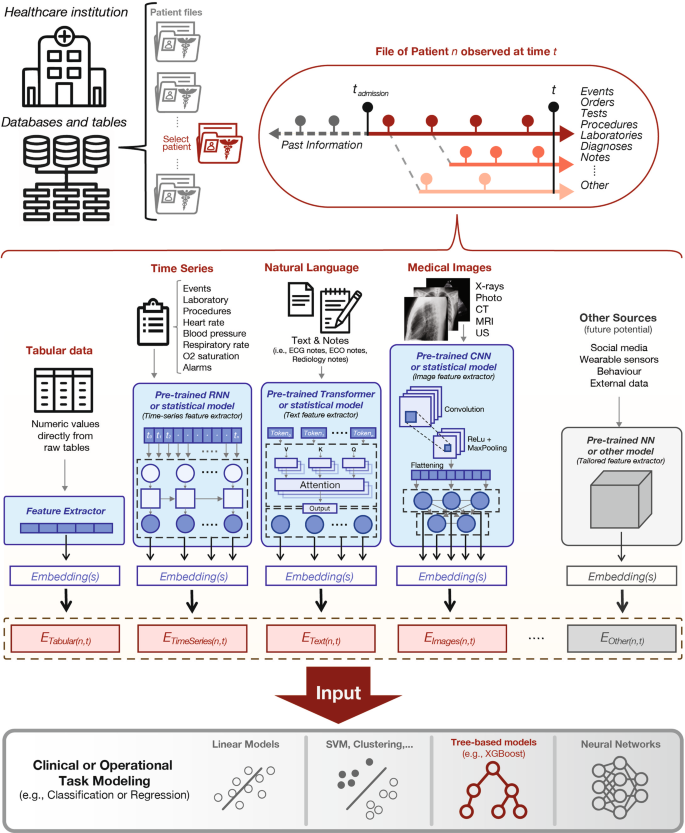
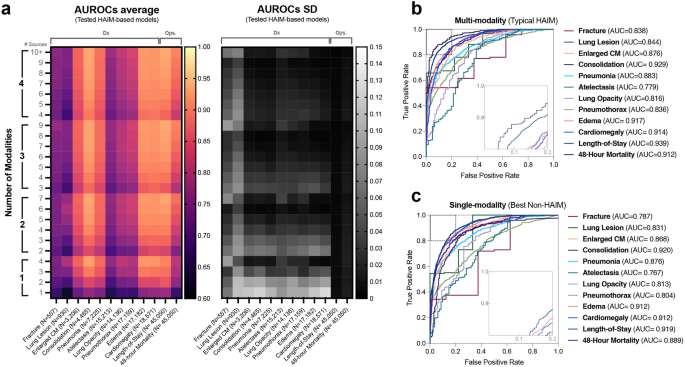
The medical-AI literature already shows how heterogeneous data can be fused. The Holistic AI in Medicine (HAIM) framework from MIT's Abdul Latif Jameel Clinic for Machine Learning in Health (Soenksen, Ma, Zeng et al., npj Digital Medicine, September 2022) takes four data modalities — tabular, time-series, text and images — from 11 data sources, turns each into an embedding (a pre-trained transformer for notes, a pre-trained convolutional network for X-rays), concatenates them into one "fusion embedding" per patient, and trains a simple downstream learner (XGBoost). On HAIM-MIMIC-MM — 34,537 samples from 7,279 hospitalizations and 6,485 patients, built from MIMIC-IV and MIMIC-CXR — the team trained and characterized 14,324 models across every combination of inputs for 12 predictive tasks (ten chest pathologies, length of stay, 48-hour mortality). Multimodal models beat the best single-source models by 6–33% AUROC (pathologies 6–22%, length of stay 8–20%, mortality 11–33%), and Shapley values quantified how much each modality contributed to each task.83 The code is open (Apache-2.0).83
Dementia-specific evidence that more data types help
For dementia itself, the pattern repeats across very different data types. Xue and colleagues (Boston University, Nature Medicine 2024) combined demographics, personal and family medical history, medication use, neuropsychological assessments, functional evaluations and multisequence MRI from 51,269 participants in nine cohorts to classify thirteen labels (normal cognition, MCI, dementia and ten etiologies): micro-averaged AUROC 0.94 for the three-way stage call and 0.96 for the etiologies; in 100 cases, neurologists assisted by the model outperformed neurologists alone by 26.25%, and the model held an AUROC of 0.91 on an external cohort despite about 69% missing data — a property any real-world integration layer will need.84
Consumer devices carry signal too. In the Lilly–Evidation–Apple feasibility study (2019), 113 people aged 60–75 (31 with MCI or mild Alzheimer's dementia) used an iPhone, Apple Watch, iPad and a Beddit sleep monitor for 12 weeks; passive sensor data, mood and energy surveys and active tasks (dragging shapes, tapping, reading, typing) differentiated the symptomatic group "in ways not previously detected through common clinical screening tools".85 In the Intuition Brain Health Study (Biogen, Apple, Brigham; Nature Medicine 2025), 23,004 US adults used study iPhones and Apple Watches; a logistic-regression classifier on 205 features — keyboard metrics such as taps per minute, device and app use, speech detection, motion, heart rate, sleep and steps — identified MCI with a mean AUROC of 0.85 (sensitivity 80.2%, specificity 78.7%, accuracy 79.1%, negative predictive value 92.3%).86 Speech alone predicted progression from MCI to Alzheimer's within six years with 78.5% accuracy and 81.1% sensitivity in 166 Framingham participants,87 and a 2025 meta-analysis of 54 studies pooled speech-based MCI detection at 80% accuracy, 80% sensitivity and 77% specificity.88 Blood now joins the list: on 16 May 2025 the FDA cleared the first blood test for Alzheimer's diagnosis — Fujirebio's Lumipulse G pTau217/β-Amyloid 1-42 plasma ratio — for adults 55+ with cognitive symptoms in specialist settings; 91.7% of positives were confirmed amyloid-positive by PET or CSF and 97.3% of negatives negative, with fewer than 20% of 499 samples indeterminate.90 Japan filed the same test in November 2025; lecanemab (レケンビ), approved in Japan on 25 September 2023, requires amyloid confirmation by PET or CSF, MMSE ≥ 22 and CDR 0.5–1 before use.91 Gait matters: in 26,802 adults across 17 countries, "motoric cognitive risk syndrome" (slow gait plus a cognitive complaint) had a prevalence of 9.7% and roughly doubled the risk of incident cognitive impairment (HR 2.0) and dementia (HR 1.9).95 And the home is a sensor: Oregon's ORCATECH platform has collected continuous in-home data since 2004 in more than 480 homes, up to eight years per home,96 and an electronic pillbox study found adherence of 86.8% in cognitively intact elders versus 63.9% in those with mild decline.98
Source: Butler et al., Nature Medicine 2025.86
One caution from the literature: research is still imaging-heavy. A systematic review of 255 AI studies in dementia neuroimaging found structural MRI in about 71%, 71% relying on the single ADNI dataset, and few validating in an independent cohort.89 The real-world data in the table below — behaviour, speech, the home, care records, the person's own ratings — is exactly what research under-uses and exactly what a marketplace generates every day.
The full list: every type of data a personalized dementia service needs
Grouped the way HAIM would ingest it. "Modality" is the HAIM-style stream (tabular, time-series, text, image, audio). "Phone/Watch" marks what an iPhone and Apple Watch can capture today: yes natively via HealthKit or built-in features, partial via apps, research frameworks or third-party devices, no. "Lives in" names the system that holds it in Japan (and the US/EU equivalent where relevant).
| Data type | Examples, instruments, ranges | Lives in | Modality | Phone/Watch | Src |
|---|---|---|---|---|---|
| A · Cognitive, functional and behavioural assessments | |||||
| Global cognition | MMSE (0–30; <24 impaired); MoCA (0–30; ≥26 normal); HDS-R 改訂長谷川式 (0–30; ≤20 suspected dementia); CANTAB-type digital tests | Memory clinic, GP; 主治医意見書 | Tabular | partial | 101 |
| Staging | CDR global 0 / 0.5 / 1 / 2 / 3 (CDR-SB); FAST | Specialist clinic | Tabular | no | 101 |
| Disease-specific cognition | ADAS-Cog (11 items, 0–70, higher = worse) | Clinic / trials | Tabular | no | 101 |
| Daily function (ADL / IADL) | Barthel Index (0–100, LIFE item); Lawton IADL (0–8); FIM; 障害高齢者 / 認知症高齢者の日常生活自立度 (Ⅰ, Ⅱa, Ⅱb, Ⅲa, Ⅲb, Ⅳ, M) | 要介護認定 survey (74 items); LIFE; care records | Tabular | partial | 101, 75 |
| Care level | 要支援1–2, 要介護1–5, by 要介護認定等基準時間 (25 → 110+ min/day); US equivalent: GUIDE complexity tier | 介護保険 / municipality; CMS | Tabular | no | 101, 63 |
| Behavioural & psychological symptoms (BPSD) | NPI (12 domains, frequency × severity, 0–144, carer distress 0–5); DBD13 (0–52, LIFE item); Vitality Index; agitation, sleep disturbance, wandering episodes | Clinic; LIFE; care records | Tabular | partial | 101, 75 |
| Mood | GDS-15 (≥5 suggests depression); PHQ-9; HKStateOfMind (valence, labels; iOS 18+) | Clinic; phone | Tabular | yes | 101, 94 |
| Nutrition, oral, swallowing | MNA-SF (0–14; ≤7 malnourished); BMI, weight trend, serum albumin; 食事形態, 誤嚥性肺炎既往 (LIFE); oral function; hydration | LIFE; dietitian; dental | Tabular | partial | 101, 75 |
| Social connection | UCLA Loneliness Scale v3 (20–80); Lubben social network; frequency of contact; participation in 認知症カフェ etc. | Self-report; community | Tabular | partial | 101 |
| Carer burden | Zarit Burden Interview (22 items, 0–88; >60 severe); carer depression/anxiety screens; hours of care per day | Self-report (carer) | Tabular | partial | 101, 41 |
| Quality of life (PROMs) | QOL-AD (13 items, self and proxy); DEMQOL (28) / DEMQOL-Proxy (31); QUALID (11); QUALIDEM (40); CANE self-rated needs | Self-report; research | Tabular | partial | 101, 22 |
| B · Biomarkers, imaging and genetics | |||||
| Blood biomarkers | Plasma p-tau217, Aβ42/40 ratio (Lumipulse G pTau217/Aβ1-42 ratio, FDA-cleared 16 May 2025); p-tau181; NfL; GFAP | Hospital lab; 電子カルテ情報共有サービス (検査) | Tabular | partial | 90, 92 |
| CSF biomarkers | Aβ42/40, p-tau181/Aβ42, t-tau/Aβ42 ("Core 1" in the 2024 Alzheimer's Association criteria) | Specialist hospital | Tabular | no | 92 |
| Molecular imaging | Amyloid PET (Core 1; required before lecanemab in Japan), tau PET (Core 2), FDG-PET | Hospital PACS | Image | no | 91, 92 |
| Structural imaging | MRI (hippocampal volume, cortical thickness, white-matter hyperintensities; multisequence MRI as in Xue et al.); CT | Hospital PACS | Image | no | 84 |
| Electrophysiology | EEG / MEG (24 of 255 reviewed AI studies); ECG via Apple Watch (HKElectrocardiogram) | Hospital; watch | Time-series | partial | 89, 94 |
| Genetics | APOE ε4 (one copy ≈2–3× risk, two copies ≈8–12×); polygenic risk (APOE + PRS + age + sex: AUC 78.2%) | Genetic testing; research | Tabular | no | 93 |
| Routine labs & risk-factor tests | LDL cholesterol, HbA1c/glucose, blood pressure, TSH, vitamin B12, folate, renal and liver panels; hearing test; vision test (eight of the 14 Lancet factors are measurable) | 特定健診 / NDB; clinic | Tabular | partial | 6, 99 |
| C · Wearable and smartphone data (Apple HealthKit identifiers) | |||||
| Cardiovascular | heartRate, restingHeartRate, heartRateVariabilitySDNN / RMSSD, heartRateRecoveryOneMinute, atrialFibrillationBurden, irregular-rhythm events, oxygenSaturation, respiratoryRate, bloodPressure (3rd-party cuff) | HealthKit | Time-series | yes | 94 |
| Sleep | sleepAnalysis stages (core, deep, REM, awake, in bed), appleSleepingWristTemperature, appleSleepingBreathingDisturbances | HealthKit | Time-series | yes | 94 |
| Activity | stepCount, distanceWalkingRunning, flightsClimbed, appleExerciseTime, appleStandTime, vo2Max, timeInDaylight | HealthKit | Time-series | yes | 94 |
| Gait & mobility | walkingSpeed, walkingStepLength, walkingDoubleSupportPercentage, walkingAsymmetryPercentage, appleWalkingSteadiness (OK / Low / Very Low), stairAscentSpeed, stairDescentSpeed, sixMinuteWalkTestDistance — slow gait + complaint = MCR (HR 2.0) | HealthKit | Time-series | yes | 94, 95 |
| Falls | numberOfTimesFallen; Fall Detection (auto-on at 55+; emergency call after ~1 min immobile) | Watch | Time-series | yes | 94 |
| Hearing exposure | environmentalAudioExposure, headphoneAudioExposure (hearing loss is a Lancet factor) | HealthKit | Time-series | yes | 94, 6 |
| Device-interaction (digital phenotyping) | Keyboard metrics (taps per minute), app and device use, speech detection, accelerometer/gyroscope (SensorKit, research entitlement) — 205 features in the Intuition classifier | SensorKit (research) | Time-series | partial | 86 |
| Active cognitive tasks | Dragging shapes, tapping, reading, typing tasks (Lilly–Evidation–Apple); CANTAB on phone; CFI-14, E-Cog-12 surveys | Study app | Tabular | partial | 85, 86 |
| Medications (device-side) | HKUserAnnotatedMedication (iOS 26+): schedule, logged doses, archived status → adherence | HealthKit | Tabular | yes | 94 |
| Clinical records on device | HKClinicalTypeIdentifier (FHIR): allergies, conditions, immunizations, lab results, medications, procedures, vital signs, clinical notes, coverage | HealthKit Health Records (US, UK, Canada) | Tabular Text | yes | 94 |
| D · Speech and language | |||||
| Acoustic features | Pauses, speech rate, prosody, voice quality (eGeMAPS / ComParE sets) | Phone mic; voice assistants; call recordings | Audio | partial | 103 |
| Linguistic features | Lexical diversity, syntactic complexity, semantic coherence from picture description (Cookie Theft; ADReSS 156 participants) or free conversation | ASR transcripts | Text | partial | 103, 87 |
| Ambient conversation analytics | In-home audio AI yielding 100+ insights (falls, infection signs, cognitive or emotional change, loneliness) — Sensi.AI | Home audio pod | Audio | no | 80 |
| E · Home and ambient sensing | |||||
| Movement in the home | Ceiling/wall PIR sensors (in-home walking speed, room transitions), door contacts, under-mattress sleep sensor, scale, digital pillbox — the ORCATECH set | Home sensor platform | Time-series | no | 96 |
| Appliance and utility signals | Electric kettle use (象印 みまもりほっとライン, since 2001); smart-meter electricity patterns (TEPCO since 2017; 中部電力 テラシテ since 2022, ¥550/month); water, gas | Utility / appliance maker | Time-series | no | 97 |
| Location | GPS trackers lent by municipalities (e.g. 尼崎市), geofences, Find My; wandering episodes (17,345 police reports in 2025) | Tracker vendor; phone | Time-series | yes | 97, 11 |
| Medication adherence hardware | Electronic pillbox events (adherence 86.8% vs 63.9% by cognition) | Pillbox vendor | Time-series | partial | 98 |
| Cameras, smart speakers | Visual monitoring and voice interaction — highest-value and highest-risk; the resident's perspective is the least studied | Vendor cloud | Image Audio | no | 33 |
| Environment | Indoor temperature and heat (median NPI rose 13 → 24.5 in a 30.4 °C week), season, air quality (pollution is a Lancet factor), noise, light | Home sensors; weather APIs | Time-series | partial | 102, 6 |
| F · Clinical and care records | |||||
| EHR structured data | Diagnoses (ICD-10/11), medication list (polypharmacy, anticholinergic burden), allergies, lab results, vitals, procedures, immunizations | Hospital/clinic EHR; Japan 電子カルテ情報共有サービス (6 items: 傷病名・アレルギー・感染症・薬剤禁忌・検査・処方, from 2025) | Tabular | partial | 99 |
| Clinical free text | Progress notes, radiology reports, discharge summaries (退院時サマリー), referral letters (診療情報提供書) — the "text" stream in HAIM | EHR | Text | no | 83, 99 |
| Long-term-care assessment | 要介護認定 (74-item survey + 主治医意見書); 課題分析標準項目 23 items (health, ADL, IADL, cognition, communication, daily rhythm, continence, hygiene, oral, nutrition, social ties, family, housing) | Municipality; care manager | Tabular Text | no | 99 |
| Care plan & care records | ケアプラン (居宅サービス計画書), service schedule, daily 介護記録 (care logs), incident reports, LIFE submissions (Barthel, DBD13, Vitality Index, nutrition, oral, pressure ulcers, continence, history, medications) | Care-record software; LIFE | Tabular Text | no | 75 |
| Claims & health-check data | NDB (medical claims + 特定健診), 介護DB (certification + LTC claims), linked since Oct 2020; US Medicare claims | MHLW databases | Tabular | no | 99 |
| Pharmacy / PHR | 薬剤情報 and 特定健診 results via the マイナポータル PHR API; お薬手帳 apps | マイナポータル | Tabular | yes | 99 |
| Interoperability standards | HL7 FHIR (Apple Health Records; EU EHDS), SS-MIX2 (HL7 v2.5 standard storage: 患者基本・処方・検体検査・病名), openEHR archetypes, LIFE CSV | — | — | — | 94, 100 |
| G · Social, environmental and life context | |||||
| Living situation | Alone / with spouse (old-old care 63.5%) / with children; caregiver availability and employment (3.65M working carers); distance to family | Care manager assessment; self-report | Tabular | no | 15, 14 |
| Economic & insurance | Care level and co-payment share (負担割合), income band, pension, private dementia insurance, employer benefits, GUIDE/Medicare eligibility | Municipality; insurer | Tabular | no | 63 |
| Housing & neighbourhood | Stairs, bathing, kitchen safety, accessibility; distance to 地域包括支援センター, clinics, day services, 認知症カフェ; transport | Assessment (居住環境); maps | Tabular | partial | 99 |
| Life history & preferences | "This is me" (Alzheimer's Society): background, significant people and places, routines, food, music, faith; ライフヒストリー; the five values (autonomy, burden, control, family, safety) | Family; care records | Text | partial | 102, 23 |
| Advance care planning & legal | 人生会議 / ACP documents, advance directives, guardianship (成年後見), family trust (家族信託), power of attorney, 48% unmet legal/ACP need | Family; lawyer; municipality | Text | no | 102, 46 |
| Social determinants | Education (a Lancet factor), social isolation, employment history, language, culture | Self-report | Tabular | no | 6 |
| H · Patient- and carer-generated data (the marketplace feedback loop) | |||||
| Self-rated needs & QoL | CANE self-rating, QOL-AD self-report, psychological distress — the ratings that differ from proxies (1.17 vs 2.64) | App; interviews | Tabular | yes | 24 |
| Diaries & EMA | Mood, sleep and symptom diaries; ecological momentary assessment prompts; food and hydration logs | App | Tabular Text | yes | 94 |
| Carer observations | NPI informant ratings, DBD13, incident notes, "good day / bad day" logs, Zarit re-ratings | App; LIFE | Tabular Text | yes | 101 |
| Service outcomes | Satisfaction, unmet-needs re-rating after each service, days at home, hospitalizations, falls, carer stress — what GUIDE pays on and what the match model learns from | Marketplace | Tabular | yes | 63, 47 |
How it would fit together
A HAIM-style integration layer for one person: eight source groups, five modality encoders, one fusion embedding, five downstream tasks, and the marketplace they serve — with outcomes flowing back. Governance and standards run underneath every arrow.
The questions this leaves open
Whose consent, in what order?
Health data is 要配慮個人情報 under Japan's Act on the Protection of Personal Information: it requires prior consent and cannot be shared with third parties on an opt-out basis.100 The GPS literature shows families deciding on the person's behalf;26 a marketplace must get the person's consent first, early, while capacity is intact — which argues for starting at MCI, not after diagnosis.Which rails exist already?
The Next-Generation Medical Infrastructure Act allows pseudonymized medical data for research since April 2024 (three certified producers, 158 cooperating institutions, about 5.12 million people's records);100 the 電子カルテ情報共有サービス exchanges six core items from 2025;99 LIFE already holds care-side data for 53,000+ facilities;75 HealthKit exposes a person's own device data with per-type consent.94 The EU's EHDS, in force since 26 March 2025, phases in cross-border patient summaries from 2029 and images and labs from 2031.100How to handle missing data?
Real profiles will be sparse — the external cohort in Xue et al. had about 69% missing data and the model still reached AUROC 0.91.84 The integration layer must be designed for absence, and must say what it does not know.What is the measure of "fit"?
Quality is measured today (AUROC, response time). Fit needs its own metrics: the person's self-rated unmet needs (not the proxy's), days living at home (MIND at Home's HR 0.63), carer stress (Zarit), and whether the person would choose the same service again.24,47Who holds the profile?
The hospital, the care manager, the platform or the person? The person-controlled option — a PHR seeded from マイナポータル and HealthKit — is the only one that keeps the ordering in the first question right.What do older adults actually want from it?
The literature says the person's answer differs from the family's. The next step for me is to ask people over 65 directly — what they think of such a service and which functions they would want — before freezing a single feature.Dementia is the mismatch problem of the ageing century: four groups who want the same outcome and keep buying, building and rating different things. Personalization is the fix, a marketplace is the mechanism, and data integration is the work. That is what I have to think about next.
Sources
All URLs were opened on 2 October 2026 unless marked †, which indicates a secondary report of a primary document that could not be opened directly. Figures in this note are quoted as published; where two sources differ, both are given in the text.
- World Health Organization. Dementia — Fact sheet (data for 2021; cost for 2019). who.int
- WHO. World failing to address dementia challenge — Global status report on the public health response to dementia, press release, 2 Sep 2021. who.int
- Alzheimer's Disease International. Dementia statistics. alzint.org
- GBD 2019 Dementia Forecasting Collaborators. Estimation of the global prevalence of dementia in 2019 and forecasted prevalence in 2050. Lancet Public Health 2022;7:e105–e125. PMC8810394
- ADI. World Alzheimer Report 2021: Journey through the diagnosis of dementia (abridged). PDF · press release, 21 Sep 2021. alzint.org
- Livingston G, et al. Dementia prevention, intervention, and care: 2024 report of the Lancet standing Commission. Lancet 2024;404:572–628. doi · summary: Alzheimer Europe
- 厚生労働省(研究代表者 二宮利治・九州大学)「認知症及び軽度認知障害の有病率調査並びに将来推計に関する研究」令和5年度老人保健健康増進等事業, 2024. mhlw.go.jp (PDF)
- 「認知症施策推進基本計画」閣議決定, 2024年12月3日. mhlw.go.jp (PDF)
- 厚生労働省「認知症施策推進総合戦略(新オレンジプラン)」概要, 2015. mhlw.go.jp (PDF)
- 慶應義塾大学医学部(佐渡充洋ほか)「わが国における認知症の経済的影響に関する研究」2015. keio.ac.jp · 2060年推計: KOMPAS
- 警察庁「行方不明者の状況」令和5年・6年・7年. R5 (PDF) · R6 (PDF) · R7 (PDF) · 2012–2013 values: nippon.com, facial-lykaon.com†
- 厚生労働省「介護保険事業状況報告(暫定)」令和8年6月分. mhlw.go.jp (PDF)
- 内閣府「令和8年版高齢社会白書」第1章第1節. cao.go.jp
- 総務省統計局「令和4年就業構造基本調査 結果の概要」. stat.go.jp (PDF)
- 厚生労働省「2022(令和4)年 国民生活基礎調査の概況」IV 介護の状況. mhlw.go.jp (PDF)
- 厚生労働省「第9期介護保険事業計画に基づく介護職員の必要数について」2024年7月12日. mhlw.go.jp
- 内閣官房「共生社会の実現を推進するための認知症基本法」資料. cas.go.jp (PDF)
- 全国キャラバン・メイト連絡協議会「認知症サポーターの人数」令和8年6月30日現在. caravanmate.com
- 보건복지부「2023년 치매역학조사 결과」2025년 3월 12일. korea.kr · 서울경제 보도. sedaily.com
- 중앙치매센터「대한민국 치매현황 2024」(디멘시아뉴스 보도). dementianews.co.kr†
- Alzheimer's Association. 2025 Alzheimer's Disease Facts and Figures. alz.org · 2026 edition. alz.org
- Römhild J, et al. Inter-rater agreement of the Quality of Life-Alzheimer's Disease (QoL-AD) self-rating and proxy rating scale. Health Qual Life Outcomes 2018. PubMed
- Reamy AM, Kim K, Zarit SH, Whitlatch CJ. Understanding discrepancy in perceptions of values. Gerontologist 2011. PubMed · four-year follow-up, 2013. PubMed
- Miranda-Castillo C, Woods B, Orrell M. The needs of people with dementia living at home from user, caregiver and professional perspectives. BMC Health Serv Res 2013;13:43. BMC · 2010 companion paper. PubMed
- van der Roest HG, et al. What do community-dwelling people with dementia need? Int Psychogeriatr 2009. PubMed
- Landau R, et al. Families' and professional caregivers' views of using advanced technology to track people with dementia. Qual Health Res 2010. PubMed · Who should make the decision on the use of GPS? Aging Ment Health 2011. PubMed
- 内閣府「認知症に関する世論調査」令和7年8月調査. gov-online.go.jp
- Phillips B, Zhao H. Predictors of assistive technology abandonment. Assist Technol 1993;5:36–45. PubMed
- Ienca M, et al. Intelligent assistive technology for Alzheimer's disease and other dementias: a systematic review. J Alzheimers Dis 2017. PubMed · Ienca M, et al. Ethical design of intelligent assistive technologies for dementia. Sci Eng Ethics 2018. Springer
- Koo BM, Vizer LM. Mobile technology for cognitive assessment of older adults: a scoping review. JMIR mHealth uHealth 2019;7(11):e15122. JMIR
- Span M, et al. Involving people with dementia in the development of supportive IT applications. Ageing Res Rev 2013. PubMed · Meiland F, et al. Technologies to support community-dwelling persons with dementia: INTERDEM position paper. JMIR Rehabil Assist Technol 2017. PubMed · Neal D, et al. Umbrella review. Digital Health 2025. SAGE
- Gibson G, et al. The everyday use of assistive technology by people with dementia and their family carers. BMC Geriatr 2015. PubMed
- Niemeijer AR, et al. Ethical and practical concerns of surveillance technologies in residential care for people with dementia or intellectual disabilities. Int Psychogeriatr 2010. PubMed
- 日本総合研究所「認知症の人の消費・市場規模に関する推計」2025年2月21日. jri.co.jp (PDF)
- 経済産業省ロボット市場予測(2013年; 産業タイムズ報道). sangyo-times.jp† · 矢野経済研究所「介護ロボット市場に関する調査」2022. dreamnews.jp · 矢野経済研究所「介護DX市場」2024. yano.co.jp
- 厚生労働省 社会保障審議会介護給付費分科会 第255回資料「介護テクノロジーの導入状況等」2026. mhlw.go.jp (PDF)
- 厚生労働省「介護テクノロジー等による生産性向上の取組に関する調査及び効果測定事業」報告, 2026. mhlw.go.jp (PDF)
- 介護労働安定センター「令和6年度 介護労働実態調査」結果の概要. kaigo-center.or.jp (PDF)
- 厚生労働省 社会保障審議会福祉部会福祉人材確保専門委員会 資料, 2025. mhlw.go.jp (PDF)
- WHO. Health workforce overview (projected shortfall of about 11 million health workers by 2030). who.int
- Sallim AB, et al. Prevalence of mental health disorders among caregivers of patients with Alzheimer disease. J Am Med Dir Assoc 2015. PubMed
- ADI. World Alzheimer Report 2022: Life after diagnosis. alzint.org · Newcastle University summary. ncl.ac.uk
- ADI. World Alzheimer Report 2019: Attitudes to dementia. alzint.org
- 認知症介護研究・研修仙台センター 平成29年度調査「空白の期間」(designing for dementia 紹介記事). designing-for-dementia.jp† · 日本老年医学会雑誌 63(1). J-STAGE
- AARP. 2021 Home and Community Preferences Survey, press release, 18 Nov 2021. aarp.org
- Black BS, et al. Unmet needs of community-residing persons with dementia and their informal caregivers: findings from the MIND at Home study. J Am Geriatr Soc 2013;61:2087–2095. Wiley · summary. ScienceDaily
- Samus QM, et al. A multidimensional home-based care coordination intervention for elders with memory disorders: the MIND at Home randomized trial. Am J Geriatr Psychiatry 2014. PubMed
- AARP. The Longevity Economy Outlook 2026. aarp.org
- Counsel Health. Series A announcement, 16 Oct 2025. BusinessWire · Fierce Healthcare · company blog · seed round, Oct 2024. HIT Consultant · chronic-condition expansion, 7 Apr 2026. BusinessWire
- Care.com. About. care.com
- Honor / Home Instead. TechCrunch, 5 Oct 2021. techcrunch.com · Home Health Care News, Jul 2024. homehealthcarenews.com
- Papa. Fierce Healthcare. fiercehealthcare.com · Refresh Miami, Aug 2026. refreshmiami.com
- Sharecare acquires CareLinx, Aug 2021. sharecare.com
- A Place for Mom. BusinessWire, 3 Feb 2026. businesswire.com · NBC News on the Senate probe, Jun 2024. nbcnews.com
- Lottie. Accel-led Series A, Oct 2023. Yahoo Finance · CareMaster acquisition, 2 Oct 2026. tech.eu
- Autumna. About us. autumna.co.uk
- Elder. elder.org
- Homage. Series C announcement, Sep 2021. homage.sg
- Wellthy. TechCrunch, 11 May 2023. techcrunch.com
- Cariloop. Series C, Apr 2024. cariloop.com · Grayce transition, Nov 2025. cariloop.com
- Carallel. Series A, Dec 2022. carallel.com
- KareHero. karehero.com†
- CMS Innovation Center. GUIDE Model. cms.gov · Payment Methodology Paper (PY2026 rates). PDF · Model overview fact sheet. PDF · CMS blog. cms.gov
- Rippl Care. GeekWire, Oct 2024. geekwire.com · Harbor Health acquisition, 10 Feb 2026. harborhealth.com
- Remo Health and Cleveland Clinic Medicare ACO, 8 Jul 2025. clevelandclinic.org
- Isaac Health. Fierce Healthcare, Aug 2025. fiercehealthcare.com
- Harmonic Health. MobiHealthNews, Oct 2023. mobihealthnews.com
- Together Senior Health and Rainier Health Network. PR Newswire. prnewswire.com
- Ceresti Health. Home Health Care News, Aug 2025. homehealthcarenews.com
- MapHabit. NIA commercialization release. maphabit.com
- 株式会社クーリエ「みんなの介護」掲載施設数, 2025年5月. PR TIMES
- LIFULL介護「LIFULL介護について」. kaigo.homes.co.jp
- 株式会社メドレー「介護のほんね」と「みんかい」の統合について, 2025年10月27日. medley.jp
- 株式会社ウェルモ「ミルモぷらん」. welmo.co.jp · 株式会社シーディーアイ「SOIN」. PR TIMES
- 厚生労働省「科学的介護情報システム(LIFE)について」. mhlw.go.jp (PDF) · 収集項目(日本作業療法士協会資料, 2021). jaot.or.jp (PDF)
- Theoria technologies「認知症関連サービスカオスマップ2025」2025年1月. PR TIMES
- トリニティ・テクノロジー株式会社 シリーズB資金調達, 2024年1月. PR TIMES
- 케어링 (Caring). WowTale, 8 May 2026. wowtale.net
- 케어닥 (Caredoc). 한국경제, Nov 2023. hankyung.com · 인더뉴스. inthenews.co.kr
- Sensi.AI. TechCrunch, 26 Jun 2024. techcrunch.com · Series C, Oct 2025. CTech
- Stanford Medicine. New AI centre for dementia care, Sep 2026. stanford.edu
- California Senate Judiciary Committee. Analysis of SB 875 (Glazer) — referral-agency disclosure requirements for residential care facilities for the elderly. senate.ca.gov (PDF)
- Soenksen LR, Ma Y, Zeng C, et al. Integrated multimodal artificial intelligence framework for healthcare applications. npj Digit Med 2022;5:149 (CC BY 4.0). nature.com · code. GitHub · project page. MIT Jameel Clinic
- Xue C, Kowshik SS, et al. AI-based differential diagnosis of dementia etiologies on multimodal data. Nat Med 2024;30:2977–2989. nature.com
- Lilly, Evidation Health and Apple. Feasibility study of digital biomarkers of cognitive impairment (KDD 2019), press release 8 Aug 2019. lilly.com · Chen R, et al. Apple ML Research
- Butler PM, et al. Smartphone- and wearable-based digital biomarkers of cognitive impairment: the Intuition Brain Health Study. Nat Med 2025;31:829–839. nature.com
- Amini S, et al. Prediction of Alzheimer's disease progression within 6 years using speech. Alzheimer's Dement 2024. Wiley · NIA summary. nia.nih.gov
- Speech-based detection of mild cognitive impairment: systematic review and meta-analysis. Age and Ageing 2025;54(10):afaf316. OUP
- Borchert RJ, et al. Artificial intelligence for diagnostic and prognostic neuroimaging in dementia: a systematic review. Alzheimer's Dement 2023. Wiley
- US FDA. FDA clears first blood test used in diagnosing Alzheimer's disease, 16 May 2025. fda.gov
- エーザイ「レケンビ」国内承認, 2023年9月25日. eisai.co.jp · 厚生労働省「最適使用推進ガイドライン レカネマブ」. mhlw.go.jp (PDF)
- Jack CR Jr, et al. Revised criteria for diagnosis and staging of Alzheimer's disease: Alzheimer's Association Workgroup. Alzheimer's Dement 2024. Wiley
- Mayo Clinic. Alzheimer's genes: Are you at risk? mayoclinic.org · Escott-Price V, et al. Common polygenic variation enhances risk prediction for Alzheimer's disease. Brain 2015. OUP
- Apple Developer Documentation — HealthKit: HKQuantityTypeIdentifier · HKClinicalTypeIdentifier · HKStateOfMind · HKUserAnnotatedMedication · Apple Support, Fall Detection. support.apple.com
- Verghese J, et al. Motoric cognitive risk syndrome: multicountry prevalence and dementia risk. Neurology 2014. PubMed
- Oregon Center for Aging and Technology (ORCATECH), OHSU. Our technology. ohsu.edu · Lyons BE, et al. Pervasive computing technologies to continuously assess Alzheimer's disease progression and intervention efficacy. Front Aging Neurosci 2015. Frontiers · NIA CART initiative. nia.nih.gov
- 象印マホービン「みまもりほっとライン」. zojirushi.co.jp · 中部電力ミライズ「テラシテ」2022年7月. chuden.co.jp · 尼崎市「認知症高齢者等GPS利用支援サービス」. city.amagasaki.hyogo.jp
- Hayes TL, et al. Medication adherence in healthy elders: small cognitive changes make a big difference. J Aging Health 2009. OHSU
- 課題分析標準項目(23項目, 令和5年10月改正)解説. hitori-cm.com† · 電子カルテ情報共有サービス(2025年開始)解説. pt-ot-st.net† · マイナポータルPHR API 連携(DeNA, 2023). dena.com · NDB・介護DB連結解析(2020). cbnews.jp
- 内閣府「次世代医療基盤法の施行状況」2025年9月. cao.go.jp (PDF) · 個人情報保護法 要配慮個人情報 解説. businesslawyers.jp · European Commission. European Health Data Space Regulation (EU) 2025/327. europa.eu · HHS. HIPAA de-identification guidance. hhs.gov
- Assessment instruments: MMSE and MoCA (Shirley Ryan AbilityLab) MMSE · MoCA · HDS-R(日本老年医学会)PDF · CDR (Knight ADRC) wustl.edu · ADAS-Cog (FDA) PDF · Zarit Burden Interview link · GDS-15 PDF · Lawton IADL PDF · MNA-SF PDF · DBD13 carenote.jp · UCLA Loneliness Scale v3 PDF · 認知症高齢者の日常生活自立度(厚労省)PDF · 要介護度と基準時間(長寿科学振興財団)tyojyu.or.jp · Dementia QoL PROMs (DOMS) dementiaresearch.org.au
- Alzheimer's Society. This is me. alzheimers.org.uk · 厚生労働省「人生会議」(ACP). mhlw.go.jp · Heat and behavioural symptoms in dementia inpatients. J Am Med Dir Assoc 2004. ScienceDirect
- Luz S, et al. Alzheimer's Dementia Recognition through Spontaneous Speech: the ADReSS Challenge. Interspeech 2020. ISCA (PDF)