1We are thinking about people with dementia
Our team at the Tokyo Forum Youth Session is studying how AI affects people with disabilities, and we chose dementia as our focus. Japan is the clearest place to see why: the numbers are large, the treatment window is narrow, and much of the risk is modifiable.
The scale in Japan
A Ministry of Health, Labour and Welfare (MHLW) study led by Professor Toshiharu Ninomiya (Kyushu University) estimated 4.432 million older adults with dementia in 2022 (12.3% of people aged 65+) and 5.585 million with mild cognitive impairment, MCI (15.5%). Together that is about 28% of older adults. The estimate projects 5.842 million with dementia and 6.128 million with MCI by 2040. Professor Ninomiya notes that MCI caught early can partly return to normal through lifestyle change, which is why prevention matters.
The treatment window
The two antibody drugs approved in Japan, lecanemab (Leqembi, on sale from December 2023) and donanemab (Kisunla, from November 2024), are indicated only for slowing progression in MCI due to Alzheimer's disease and mild dementia. In July 2026 APOE genetic testing was added to insurance coverage, and in August 2026 PMDA revised both drugs' warnings to recommend considering the test before treatment. The stage that families tend to miss is exactly the stage where treatment is possible.
Much of the risk is modifiable
The 2024 Lancet Commission estimates that about 45% of dementia cases could be prevented or delayed by addressing 14 risk factors across life: less education, hearing loss, high LDL cholesterol, depression, traumatic brain injury, physical inactivity, diabetes, smoking, hypertension, obesity, excessive alcohol, social isolation, air pollution and untreated vision loss. Hearing loss accounts for about 7%, LDL cholesterol about 7%, and vision loss about 2%.
Safety: people who go missing
Japanese police received missing-person reports for 17,345 people with dementia in 2025, about one in five of all 80,486 missing-person reports. The record was 19,039 in 2023. Of the 16,729 cases resolved in 2025, GPS devices were involved in only 139, and 118 of those people (84.9%) were found on the day the report was filed. Once 15 or more days pass, confirmed deaths outnumber survivors. In 2024, 491 people died, and 382 of them (77.8%) were found within 5 km of where they went missing.
2Four stakeholders, four agendas
When I think about dementia, the most important thing is the match and mismatch between what each group wants.
A product can be clever and still fail if it serves one group at the expense of another. These are the four groups I keep in view.
| Stakeholder | What they want | What they fear or struggle with |
|---|---|---|
| People living with dementia | Company, things to do in the day, information about care, help with distress, going out on their own, staying in their community | Being watched, being labelled, losing independence, burdening their family |
| Families | Safety, knowing where the person is, support with memory problems, less physical and emotional strain | Not noticing decline, the person going missing, their own exhaustion |
| Care professionals care managers, clinicians, care workers, navigators | Accurate signals, the right local services to recommend, fewer preventable hospital admissions | Information overload, false alarms, time pressure |
| Companies device makers, insurers, pharma, startups | Products that scale and pay: detection, monitoring, diagnostics, insurance add-ons, early identification for treatment | Low adoption, regulation of diagnostic claims, unclear payers |
So I researched whether their needs actually match. Sections 3 to 6 are the evidence; section 7 sums it up.
3What people with dementia say they need
The most consistent finding is a perception gap. People with dementia report fewer needs than their family carers report for them, and the needs they do name are about company and meaning, not safety.
They report about half the needs their carers report
In the European Actifcare study of people with middle-stage dementia living at home, the person rated an average of 0.95 unmet needs, the family carer rated 1.66 for them, and a trained researcher rated 1.85. For met needs, the person rated 5.5 and the carer 8. Carers reported almost twice as many needs, in line with earlier research.
A study by Miranda-Castillo and colleagues (2013) found the same pattern: people with dementia reported fewer needs than caregivers and professionals, and the person most often named psychological distress as their top unmet need, while caregivers most often named memory (32.5%), daytime activities (16.0%) and company (13.1%). An earlier study cited in the same paper found people with dementia naming information (34.5%), company (28%) and daytime activities (25.2%), while their caregivers named daytime activities (40%), company (36.8%) and memory (36.6%).
Unmet needs matter for outcomes. In a study of 152 people with dementia living at home, the most frequent unmet needs were daytime activities (50.7%), company (39.5%) and help with psychological distress (30.9%). More behavioural symptoms, weak community networks, a younger carer and higher carer anxiety predicted more unmet needs, and people whose carers report more unmet needs are more likely to move into a care home or die.
Living alone raises every need
Part of the gap is lost awareness
Anosognosia, being unaware of one's own deficits, is estimated to affect 20% to 80% of people with Alzheimer's dementia depending on how it is measured, and up to 80% at the dementia stage in an early study. One study found it in 13.6% to 17.3% of mild cases but 44.2% to 55.8% of moderate cases; another found 39.5% of 177 people with mild or moderate Alzheimer's at baseline. A meta-analysis suggests awareness is mildly reduced at the MCI stage and severely reduced in dementia.
Design implication: at the MCI or early stage most people can still judge their own needs. That is the window to ask for consent and record what they want, before awareness fades.
Going out alone: autonomy with support
In a UK study of 12 people with dementia, 3 caregivers and 5 older people, participants said a GPS device would help them go out independently with more confidence. They were less worried about the ethics of "tagging" than academics and the media, but wanted the device to be discreet so it would not add stigma. In a Swedish study, everyone with dementia did daily outdoor activities, mostly alone. UK users also rejected devices that beep or flash, imagining an alarm going off in a supermarket.
4How much autonomy, and where people live
Japan measures autonomy directly. The "independence in daily living of older adults with dementia" scale (認知症高齢者の日常生活自立度) is assigned during long-term care certification.
| Rank | Meaning | Examples given by MHLW |
|---|---|---|
| I | Some dementia, but largely independent at home and in society | |
| IIa | Symptoms disrupt daily life outside the home, but independent if someone keeps an eye on them | Often getting lost; noticeable mistakes in shopping, paperwork or money management |
| IIb | The same, also inside the home | Cannot manage medication; cannot stay home alone to handle phone calls or visitors |
| IIIa / IIIb | Symptoms appear and care is needed, mainly in the daytime (a) or at night (b) | |
| IV | Symptoms appear frequently and constant care is needed | |
| M | Marked psychiatric symptoms, problem behaviour or serious physical illness needing specialist care | Delirium, delusions, agitation, self-harm or harm to others |
National picture
In 2010, 2.80 million older adults were at rank II or above (9.5% of people 65+), about 60% of everyone with a care certification. Including rank I and people never certified, the estimated dementia total was about 4.39 million, plus about 3.8 million with MCI. The count excludes people who never applied for certification, who are often early-stage: exactly the people a wearable for early detection would serve.
Tokyo: the share living at home falls as autonomy falls
Tokyo's FY2013 survey found 66.2% of people at rank I or above and 59.8% at rank II or above living at home, with rank II or above projected to grow from about 270,000 to about 440,000 by 2025. About half of people at home with suspected dementia live alone or as a couple only. Tokyo repeats the survey every three years with municipal breakdowns; the latest uses a 1 November 2025 reference date.
Osaka City, April 2026
Korea, and gaps in the other regions
Korea estimated 954,789 people aged 60+ with dementia in 2024 (6.76%), publishes estimates down to district level on data.go.kr, and opened 256 dementia relief centers (치매안심센터) in every district by December 2019. Hong Kong has a high institutionalization rate compared with other developed economies, partly because community care capacity is limited. I did not find comparable public breakdowns for mainland China or the Philippines; teammates from those regions are better placed to find local sources.
5What families and the public fear
In the Cabinet Office survey published in 2025 (1,551 responses from 3,000 people aged 18+), the top worry about getting dementia oneself was burdening one's family physically or mentally (74.9%). When a family member gets dementia, the top worry was that they would cause trouble for people around them (46.5%). In 2025, 60.5% of respondents had met someone with dementia.
Shimane Prefecture's 2022 survey with Meiji Yasuda Life found the same: 75.4% feared burdening their family, and 61.5% wanted local government to focus on reducing family burden. In the 2023 survey, 82% of teenage respondents thought living in the community would be difficult with dementia. Japan's Dementia Basic Act took effect in January 2024 and promotes a "new view of dementia": that people can keep doing what they want and live with hope in their community after diagnosis. In a 2025 Nagasaki survey, 74.1% had never heard of that idea.
Fear of burden can work as common ground. A person who fears burdening their family may accept support that is framed as giving the family peace of mind, rather than as watching them.
6What companies and researchers are building
Most products target detection, monitoring and safety. The science behind passive sensing is getting strong.
What wearable signals can predict
Gait speed and stride regularity measured this way also track brain structure: in 6,412 UK Biobank participants they were associated with white matter lesions and the volume of frontal, hippocampal, insular and amygdala grey matter.
Phone and watch at scale
The Biogen and Apple "Intuition" study turned 126,640 app downloads into 23,004 enrolled US adults and collected up to 24 months of iPhone and Apple Watch data, including passive device use, surveys and repeated cognitive tests. It showed remote tests correlate with clinic tests, but it was stopped early when Biogen's priorities changed.
What the reviews warn
- A 2026 JMIR systematic review of 49 studies since 2020 concludes that wearable behavioural markers show promise for early risk stratification. Some headline accuracies are from tiny samples: 93.5% with 222 people, and about 94–95% with only 33 people (5 with dementia).
- A 2026 npj Digital Medicine review found 21 studies of 16 wearable EEG devices for MCI. MUSE 2 was the most used (7 of 21), followed by EPOC X (3 of 21). Support vector machines were used in 13 of 21 studies (61.9%). Accuracy was reported in 76.2% of studies and AUC in 38.1%, with wide variation in protocols.
- A 2026 JMIR Aging review screened 2,824 records and kept 17 studies on sedentary behaviour in MCI and dementia; evidence on differences in sedentary time was inconsistent.
- An earlier review of digital biomarkers from computerized memory tests found, for detecting MCI, sensitivity of 42.0–85.8%, specificity of 66.0–93.3% and AUC of 0.53–0.93.
Products and programs in 2025–2026
| Who | What | Status and numbers |
|---|---|---|
| Samsung Brain Health | Galaxy Watch, Ring and phone analyse voice, gait and sleep for early signs of cognitive decline; processed mainly on-device | Shown at CES 2026; in clinical validation with institutions in Korea and elsewhere; planned beta in selected markets; release date unclear; not a medical device |
| Apple | Hypertension pattern notifications on Apple Watch; hearing check and hearing assistance on AirPods Pro | Hypertension notifications live in Japan since 4 December 2025, using 30 days of optical sensor data, Series 9 or later and Ultra 2 or later; over 1 million people expected to be notified in the first year. AirPods hearing feature cleared by FDA after a 118-person trial; offered in Japan as "hearing assistance", not a regulated hearing aid. Tokai University registered a study on 26 August 2026 testing AirPods Pro 2/3 in older adults with mild hearing loss |
| FRONTEO and Shionogi (SDS-881) | AI that analyses 10+ minutes of free conversation to judge whether cognitive decline is likely | Priority review designation February 2025; clinical trial from June 2025; aiming for approval in FY2026. A consumer app on the same engine has been an add-on to Nippon Life's dementia insurance since October 2025 |
| Minder (UK Dementia Research Institute) | Passive home monitoring with low-cost devices such as sleep mats and activity sensors, plus machine learning and a clinical monitoring team | UK: over 980,000 people with dementia, about 60% at home; over a quarter of NHS beds occupied by people with dementia; about a fifth of their admissions preventable. Agitation model on 32,896 person-days from 63 people: 71.3% sensitivity, 75.3% specificity; agitation affects about 30% of people with dementia |
| CrossSense | AI companion "Wispy" on smart glasses that recognises household objects and guides people through daily tasks | Won the £1 million Longitude Prize on Dementia (March 2026). Participants named 82% of household items with the glasses vs 46% without, and 78% one hour after removing them. Public launch targeted for early 2027. The £4.4 million prize funded 24 technologies since 2022 |
| CareYaya | MedaCareLLM on smart glasses: recognises faces and objects and gives prompts through a bone-conduction earpiece | Developing models to track disease progression from video, audio and gaze data |
| Japanese municipalities and security firms | GPS trackers for people at risk of going missing | See price chart below |
Acceptance is the bottleneck
- In a 2025 survey, 74.4% of older adults were interested in wearable health monitoring, but 54.9% reported anxiety, along with worries about over-surveillance.
- In interviews, older people linked smartwatches to surveillance and loss of control in their own space, and said feedback and alerts could make them doubt their own decisions.
- A 2025 meta-synthesis of 58 studies on wearables in dementia research (only 11, or 19%, were trials) found privacy concerns in 15 studies (26%). Adherence depended on whether the person could keep remembering what the device was for, and on keeping devices simple.
- A 2025 focus-group study of 31 adults aged 65+ found reluctance to adopt fall-detection devices often came from stigma, because the devices were seen as symbols of frailty.
7Matches and mismatches
Putting sections 3 to 6 together, this is what I found.
Person and family rate needs differently: 0.95 vs 1.66 unmet needs. The person names company, information, activities and distress; the family names memory and safety.
Companies mostly sell detection and monitoring, while people ask for company and dignity. 54.9% of older adults are anxious about monitoring, and devices that signal frailty carry stigma.
Families and GPS providers: municipal GPS costs as little as 500 yen a month, yet GPS was behind only 139 of 16,729 people found in 2025.
Companies and professionals: alert models at 71% sensitivity and 75% specificity would flood families with false alarms unless clinicians filter them, as Minder does. Diagnostic claims need regulatory approval, which takes years (FRONTEO's path).
Professionals and people: up to 80% of people with Alzheimer's dementia are unaware of their own deficits, so needs must be judged partly from outside.
Going out alone: people see discreet GPS as a confidence tool, and families see it as safety. Same device, different framing.
Burden: 74.9% fear burdening their family, and families want less burden. Both point to support that relieves the family.
Early detection: drug makers need people identified at the MCI stage, wearable signals can flag risk years ahead, and people at that stage can still give consent.
Prevention: hearing and blood pressure are modifiable risks, and approved consumer tools for both already exist in Japan.
8What I realized: everyone needs a service that fits
We all need personalized services for each person with dementia. AI should not only make services better; it should make them the most suitable for each person.
The evidence shows that needs differ by person, by stage and by place: living alone versus with others, rank I versus rank III, Tokyo versus Osaka versus Seoul. A one-size product gets low adoption, the way GPS does. A good match also has to answer to all four stakeholders at once.
Examples of the autonomy tension
| Situation | Person tends to want | Family tends to want | Personalized response |
|---|---|---|---|
| Going out | Keep walking freely | Know where they are | Share location only on unusual patterns or on request, not continuously |
| Money | Keep shopping and paying | Prevent mistakes and scams | Alerts on unusual transactions, set by the person in advance |
| Medication | Take their own pills | Guarantee adherence | Remind the person first; tell family only after repeated misses |
| Daily trends | Not be told they are failing | Early warning | The person sees their trend; family sees only what the person chose to share |
| Social life | Company and purpose | Safety | Prompts for connection and activities, not just alarms |
Fit changes with stage
| Stage | Who the service is for | How it behaves |
|---|---|---|
| MCI or rank I | The person | Private by default; prevention (hearing, blood pressure, walking); records the person's own wishes while awareness is intact |
| Rank II (about 70% still at home in Tokyo) | The person, with family sharing they chose | Family sees trends and unusual events, not continuous tracking; going-out support |
| Rank III and above | Carers and family | Safety alerts, care coordination, decisions guided by Japan's MHLW guideline on supporting decision-making |
9So first, maybe we need a marketplace
If the goal is the best fit for each person, the first step is a place where the person, their family and their professionals can see and choose among services: companionship, activities, information, going-out support, prevention, diagnosis, home care and respite. The difference from a directory is that the ranking is by fit to this person, not by who pays most for placement.
10Ways to build it, and who is already trying
I found several ways to create this. Each example solves one part of the problem.
Counsel Health ("Counsel AI"), United States
Founded in 2023, Counsel combines medical AI with in-house physicians, delivered through messaging. It raised an $11 million seed round led by a16z in October 2024 and a $25 million Series A from a16z and GV in October 2025. Its physician group is licensed in all 50 states; the AI uses clinical guidelines and patient records and is trained to escalate cases that need a human. a16z describes the AI as remembering context across every interaction, so personalization improves over time. Physicians use a "clinician cockpit" that brings together records, specialty guidelines and research. Its chronic-care offer starts at $29 for a consultation with follow-up. In September 2026 it joined Medicare's ACCESS model for chronic care, and it launched Counsel Studio so other organizations can embed its care in their own apps.
Lesson: personalization comes from memory of the person plus human oversight, and distribution comes through payers and partners.
Welmo (ウェルモ), Japan
Since 2014 Welmo has run ミルモネット, a local care information platform with over 30,000 listings that connects care providers with care managers. In Fukuoka's seven wards alone there were about 2,100 care providers and over 1,100 care managers, too many to know by heart. Providers update their own pages for free, including availability, because it works as a sales channel; base data comes from MHLW open data. Its AI, ミルモぷらん, helps care managers write care plans and suggests providers filtered by services, staffing and add-ons, supporting fair introduction of several providers rather than one. Welmo has raised about ¥5.6 billion.
Lesson: professionals are a key user of the marketplace, and suppliers will keep data fresh if it brings them clients.
Lottie, United Kingdom
Founded in 2021, Lottie lets families find, compare and contact care homes, home care and retirement living, with regulator ratings and funding types on each listing. It raised a £16.35 million ($21 million) Series A led by Accel, listed over 4,000 services at that time, and has passed 10 million users. It earns from providers, including an AI enquiry handler called Eliza launched in April 2026, which keeps the service free for families.
Lesson: families will use a marketplace if it is free and trusted; providers can fund it.
CareYaya, United States
CareYaya matches families with college students studying healthcare, after background checks and video interviews; families describe their loved one's needs and are matched for one-off or ongoing care, with long-term matches prioritized. It had over 25,000 students on the platform in 2024 and was selected for the AARP AgeTech Collaborative. It also equips caregivers with AI and smart glasses to track dementia progression.
Lesson: matching the right human is part of personalization, and the carer can also collect useful data.
Medicare GUIDE model and Rippl, United States
Medicare's GUIDE model pays for dementia care coordination and management, with care navigators who connect people and caregivers to clinical and community services, caregiver training, a 24/7 support line, a monthly Dementia Care Management Payment, and up to $2,500 a year of respite care for people with moderate or severe dementia who have a caregiver. Early participants included Northwell Health, UCSF, UCLA Health, Emory and Rippl Care, and the Alzheimer's Association runs a navigation service with Rippl in Illinois, Missouri, Texas and Washington.
Lesson: when someone pays for navigation, matching becomes a business.
Insurers and public hubs, Japan and Korea
Nippon Life bundles the FRONTEO and Shionogi conversation app with its dementia insurance, and Shionogi is in talks with other insurers and aims to offer it to banks and driver's license centers. Japanese municipalities already budget for GPS programs, and community support centers (地域包括支援センター) are the local entry point for care. Korea's 256 dementia relief centers play a similar role.
Lesson: a marketplace for Japan could launch through insurers or municipalities rather than direct to consumers.
| Example | What is matched | Who pays | Role of AI |
|---|---|---|---|
| Counsel Health | Person to medical advice and physicians | Members, payers, employers, Medicare model | Remembers the person, triages, escalates |
| Welmo | Care manager to local providers | Providers and care businesses (SaaS) | Drafts care plans, suggests providers |
| Lottie | Family to care homes and home care | Providers | Handles provider enquiries; data tools |
| CareYaya | Family to student caregivers | Families pay caregivers directly | Matching; progression tracking |
| GUIDE and Rippl | Person and caregiver to services via navigators | Medicare | Not central; human navigators |
| Nippon Life and Shionogi | Policyholder to cognitive check | Insurer | Conversation analysis |
None of these yet ranks services by fit to one person with dementia across all four stakeholders. That is the gap.
11How AI already combines medical data: MIT's HAIM
To match well, the marketplace needs data about the person. Hospitals already have a pattern for combining data: the Holistic AI in Medicine (HAIM) framework from MIT, published in npj Digital Medicine in 2022.
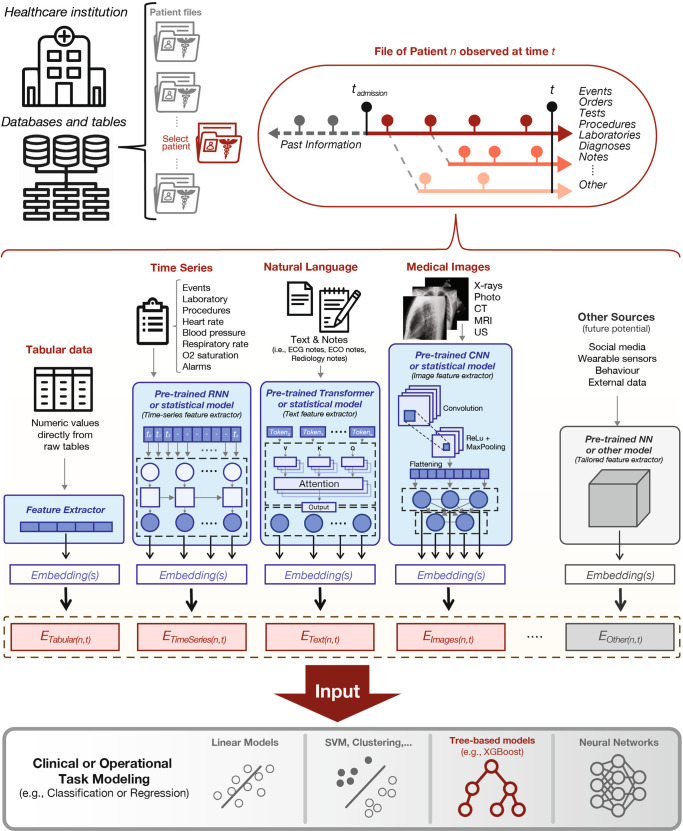
The numbers
The authors combined MIMIC-IV (de-identified records of 383,220 patients from the ICU and emergency department of Beth Israel Deaconess Medical Center in Boston, 2008–2019) with MIMIC-CXR (377,110 chest X-rays from 227,835 imaging studies). The resulting dataset had 34,537 samples from 7,279 hospital stays and 6,485 patients. They trained 14,324 models across 4 data types, 11 data sources and 12 tasks. Combining data improved results by 6–33% over single-source models. Images contributed most to chest diagnoses; time series contributed most to length-of-stay and 48-hour mortality. Each added data type helped, with diminishing returns as sources overlapped.
What HAIM collects in each data type
| Data type | In general, per the paper | What HAIM used | How it was processed |
|---|---|---|---|
| Tabular | Age, demographics, procedures, history, billing codes | 6 demographic variables | Normalized numbers |
| Time series | Pulse oximetry, blood chemistry, respiratory analysis, ECGs, ultrasound, in-vitro tests, wearable sensors | 9 chart events, 23 lab tests, 10 procedure events (full lists in section 12) | Statistics per signal: length, max, min, mean, median, SD, variance, peaks, slope and change over time |
| Text | Notes, forms, written reports, voice recordings, video | Radiology, ECG and echocardiogram reports | Clinical BERT, 768 numbers per note type; long notes split into 512-token chunks and averaged |
| Images | Photographs, X-rays, CT, MRI, pathology slides | Chest X-rays | DenseNet121 fine-tuned on CheXpert: 18 diagnosis probabilities and 1,024 features per image, also averaged across all of a patient's images |
| Other | Social media, wearable sensors, behaviour, external data; also genomics, proteomics, metabolomics | Not used ("future potential") | Any pre-trained model can be added |
Each patient file also contained admissions, transfers, provider orders, microbiology cultures, medication administrations, prescriptions, intravenous and fluid inputs, sensor outputs and billing codes. The final model was XGBoost, chosen after comparing logistic regression, decision trees, random forest, multi-layer perceptron, LightGBM and TabNet.
The box HAIM left empty, "other sources" such as wearables and behaviour, is where dementia happens: at home, between hospital visits. That is the box our project wants to fill.
12What I have to think next
How do we integrate all the medical data a marketplace needs to give each person with dementia the best service?
Below is every type of data that came up in this research, grouped the way HAIM groups data, plus the two groups a marketplace adds: care context and the person's own wishes. Integrating them raises the questions I will work on next: which data each matching decision really needs, who consents to sharing what, and how to keep the person's wishes at the start of the chain.
Tabular and profile data one-time or occasional
- Demographics: age, sex and other demographic variables
- Hospital records: admissions, transfers, provider orders, prescriptions, medication administrations, microbiology cultures
- Billing codes: diagnosis and procedure codes
- Medical history and current medication list
- Education level
- Lancet risk factors: hearing loss, high LDL cholesterol, depression, traumatic brain injury, physical inactivity, diabetes, smoking, hypertension, obesity, excessive alcohol, social isolation, air pollution, untreated vision loss
- Genetics: APOE genotype
- Blood biomarkers: amyloid beta, phosphorylated tau 217
- Cerebrospinal fluid tests
- Omics: genomics, proteomics, metabolomics
Time series in hospital and in daily life
- Bedside vital signs: heart rate, systolic and diastolic blood pressure, respiratory rate, SpO2, Glasgow Coma Scale (verbal, eye, motor)
- Lab tests: glucose, potassium, sodium, chloride, creatinine, urea nitrogen, bicarbonate, anion gap, hemoglobin, hematocrit, magnesium, platelet count, phosphate, white blood cells, total calcium, MCH, red blood cells, MCHC, MCV, red cell distribution width, neutrophils, vancomycin
- Procedures: urinary catheter, PICC line, intubation, peritoneal dialysis, bronchoscopy, EEG, continuous renal replacement therapy, dialysis with catheter, chest tube removal, hemodialysis
- Other clinical signals: pulse oximetry, blood chemistry, respiratory analysis, ECG, ultrasound, in-vitro tests, intravenous and fluid inputs, sensor outputs
- Gait from a watch or phone: usual and maximal walking speed, daily steps, cadence, step-time variability, stride regularity, running duration, walking steadiness
- Daily rhythm and sleep: bedtime, sleep duration and stages, rhythm strength (relative amplitude), fragmentation, day-to-day consistency, timing of peak activity, sedentary time
- Cardiovascular: heart rate, heart rate variability, blood pressure, 30-day hypertension pattern notifications
- Hearing: hearing checks and audiograms over time, noise exposure
- Brain signals: wearable EEG (for example MUSE 2, EPOC X)
- Home sensors: sleep mats, motion sensors, appliance use
- Location: outings, routes, getting lost, GPS alerts
- Phone use: passive device-use patterns, calls and social contact
- Repeated cognitive tests: monthly and high-frequency smartphone tests, twice-yearly surveys of memory concerns
- Events: falls, missed medication, agitation episodes, infection risk, hospital admissions, going missing
Text and voice
- Clinical notes: radiology, ECG and echocardiogram reports; physician and nursing notes; forms; written reports
- Speech: free conversation of 10 minutes or more, voice patterns, voice recordings
- Needs assessments: company, daytime activities, information, psychological distress, memory, eyesight and hearing, accidental self-harm, benefits, rated by the person, the carer and professionals
- Self-reports: surveys, diaries, subjective memory concerns
- Caregiver reports: observations and caregiver burden measures
Images and video
- Medical imaging: X-rays, CT, MRI (brain atrophy, white matter lesions), amyloid PET, ultrasound
- Other images: photographs, pathology slides
- Smart-glasses data: video, audio and gaze from glasses such as CrossSense and CareYaya
Care context what a marketplace adds
- Autonomy: rank I to M on the Japanese scale, or very mild to severe
- Care level: long-term care certification (support 1–2, care 1–5)
- Living situation: alone, couple only, with family; at home, group home or facility
- Region: municipality, local services, public programs and subsidies
- Coverage: insurance, municipal programs, ability to pay
- Service data: what each provider offers, staffing, availability, price, ratings and reviews
- External data: social media, behaviour, environment
The person's own wishes the data that makes it personal
- What they want to keep doing by themselves
- What they will share, and with whom: family, professionals, companies
- Consent settings, recorded early while awareness is intact
- Preferences about company, activities, information and how they want to be reminded
SourcesReferences
- MHLW (2024). Dementia and MCI prevalence and projections. mhlw.go.jp
- Jiji Press (2024). Ninomiya on MCI and projections. jiji.com
- PMDA (2026). Revision of lecanemab and donanemab precautions; APOE testing. pmda.go.jp
- Livingston et al. (2024). Dementia prevention, intervention, and care: 2024 Lancet Commission. doi.org; RACGP summary
- National Police Agency data via Kyodo (2026). sakigake.jp; ANN; nippon.com; CareNet 2024; Jiji 2023; Hiroshima police 2021; Gendai 2022
- Actifcare (2017). Needs and quality of life of people with middle-stage dementia. doi.org
- Miranda-Castillo et al. (2013). Needs of people with dementia living at home. BMC Health Services Research
- Miranda-Castillo et al. (2010). Unmet needs, quality of life and support networks. PubMed
- People with dementia living alone (2024). International Psychogeriatrics
- Anosognosia: Revista de Neurología; J Alzheimer's Dis; meta-analysis; Frontiers 2024; Frontiers 2025
- McCabe and Innes. Supporting safe walking for people with dementia. UHI; Swedish GPS study PMC; Community Care
- Japanese autonomy scale and national estimates: MHLW via Osaka Prefecture; MHLW 2013; MHLW 2018 chart
- Tokyo distribution surveys: FY2016; FY2013; households; FY2025 survey
- Osaka City (2026). Older adults with dementia by autonomy rank. city.osaka.lg.jp
- Korea: 2012 survey; 2025 estimates; costs; 2024 prevalence; dementia relief centers
- Hong Kong long-term care overview. STRIDE
- Cabinet Office surveys: 2025 results; 2025 report; 2019 results; 2015 report
- Shimane Prefecture surveys: 2022; 2023. Nagasaki Prefecture survey (2025): pref.nagasaki.lg.jp
- Chan et al. Watch Walk, UK Biobank. International Psychogeriatrics; brain structure GeroScience
- Circadian rhythms and dementia, Neurology (2026). UT Southwestern; ScienceDaily; Earth.com
- Butler et al. (2025). Intuition study, Nature Medicine. nature.com; Alzforum
- Cejudo et al. (2026). AI and wearables for early detection. JMIR; full text
- Wearable EEG for MCI (2026). npj Digital Medicine; sedentary behaviour review JMIR Aging; digital cognitive biomarkers J Clin Med
- Samsung Brain Health: Digital Health News; Elektroniknet
- Apple: hypertension notifications in Japan; AirPods hearing feature; Tokai University trial
- FRONTEO and Shionogi: trial start; Nikkei on the app
- Minder, UK DRI: ukdri.ac.uk; NHS integration study; agitation tool medRxiv
- CrossSense and the Longitude Prize: Nesta; trial results
- CareYaya: TechCrunch; AARP AgeTech; smart glasses
- GPS programs and prices: Minato; Bunkyo; Fukuoka; Sanjo; Kofu
- Acceptance: wearable survey 2025; privacy in smart homes; meta-synthesis; focus groups
- Counsel Health: Series A; a16z; HIT Consultant; seed; chronic care; ACCESS model
- Welmo: ASCII; AIsmiley; The Bridge; INITIAL
- Lottie: lottie.org; Silicon Canals
- Medicare GUIDE model: CMS; Fortune; LeadingAge
- Soenksen et al. (2022). Integrated multimodal AI framework for healthcare applications (HAIM). PMC; doi.org